
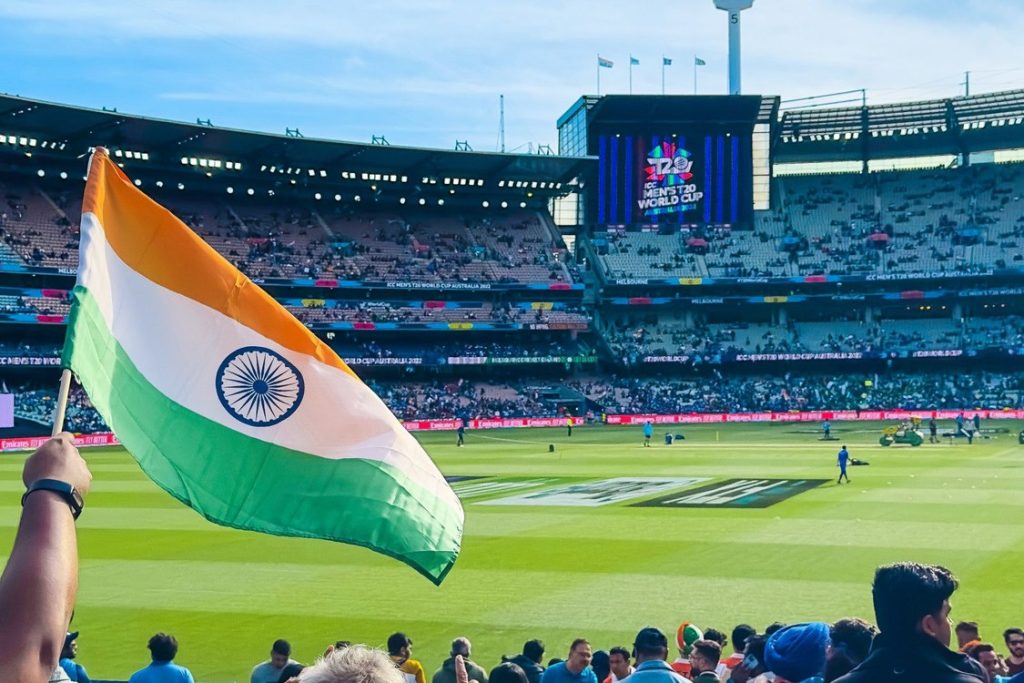
Picture the scene. Friends or family are glued to a match. The room erupts at something that looked to you like a man tapping a ball gently into the grass, and somebody says the words “we needed that wicket” like it explains everything. Cricket has a reputation for being the most complicated sport on earth, guarded by men in white and a rule book written in another century. The reputation is exaggerated. It looks harder than it is. Learning how to understand cricket is mostly learning a handful of ideas in the right order, and the first of them fits in a single sentence.
The honest shortcut is this: cricket explained simply is a contest between one team trying to score points called runs, and the other team trying to stop them and get their players out. Everything else, the formats, the funny fielding names, the score in the corner of the screen, is decoration on that frame. This guide builds the frame first, then adds the decoration in the order you will actually meet it during a match. By the end, how to understand cricket will feel less like studying a law book and more like being let in on a game your friends have been enjoying without you.
Key Points
- The whole game in one sentence: two teams take turns batting and bowling, and the side with more runs wins.
- Only three words unlock everything: runs (points), wickets (batters out — ten end an innings) and overs (six balls each, the clock of the game).
- Start with a T20, about three hours, before ODIs or five day Tests.
- Read the TV score as runs/wickets (184/6) plus overs, and follow the required run rate in a chase.
- LBW simply means the leg cannot be used as a shield for the stumps.
- Learn six fielding names — keeper, slips, point, cover, mid off, long on/off — and fake the rest.
In This Guide
- The Whole Game in One Sentence
- Runs, Wickets and Overs: The Three Words That Unlock Everything
- The Three Formats, and Which One to Watch First
- How to Read the Score in the Corner of the TV
- How a Batter Gets Out, and What LBW Actually Means
- Fielding Positions: Learn Six Names and Fake the Rest
- What to Actually Watch During Your First Match
- Frequently Asked Questions
- The Short Version
The Whole Game in One Sentence
Here is the sentence: two teams of eleven take turns batting and bowling, the batting team scores as many runs as it can before it runs out of players or time, and the team with more runs at the end wins. That is genuinely most of how to understand cricket, and you can watch a whole match holding only that thought.
A few words in it carry more weight than they look. A team’s turn at batting is called an innings. While one team bats, the other team bowls and fields, and the two jobs swap when the innings ends. The batting side always has two batters on the field at once, one at each end of the pitch, which is the strip of ground in the middle, 22 yards long, with a set of three wooden stumps at each end. The bowler delivers the ball toward one batter, who tries to hit it and score runs, while the partner waits at the far end ready to run. When a batter is out, the next teammate comes in to replace them, and the innings ends when ten of the eleven are out, because one batter cannot bat alone. Keep that picture in your head, because it is the fixed point every other part of how to understand cricket hangs from, and most of what follows is detail. It is also worth noticing how many cricket rules for beginners lists bury this picture under terminology. Here it comes first, on purpose.
Runs, Wickets and Overs: The Three Words That Unlock Everything
Most cricket basics for beginners drown you in fifty terms at once. Start smaller. The working core of how to understand cricket is three words, and every score, headline and argument in the room is built from them.
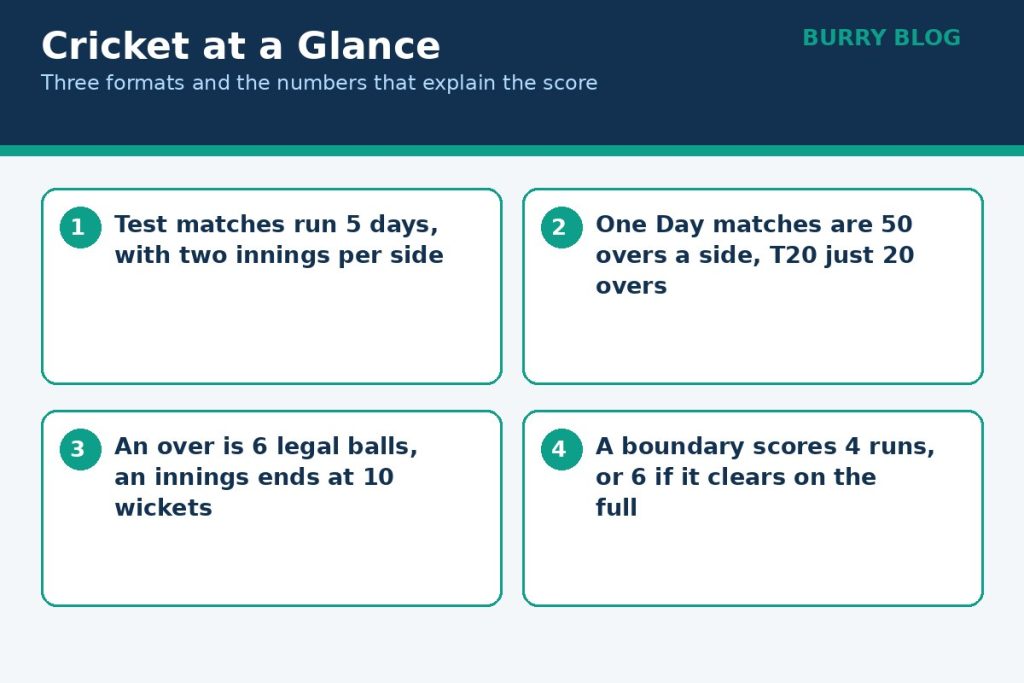
A run is the point. Batters score runs mainly in two ways. They hit the ball and run to the other end of the pitch, swapping places, and each completed swap is one run. Or they hit the ball to the boundary rope around the field: four runs if the ball bounces on its way, six runs if it flies over on the full, which is the shot that gets the biggest cheer. A wicket is a batter getting out. The word doubles up in a confusing way, because the stumps are also called the wicket, but on the scoreboard it simply means one batter has been dismissed, and ten wickets end the innings. An over answers the question what is an over in cricket in six words: six balls bowled by one bowler. After each over, a different bowler bowls from the opposite end, and no bowler may bowl two overs in a row. Overs are the clock of the game. They are how a match is rationed, and counting them down is how you know whether the batting team is cruising or in trouble. That small act of counting, overs gone against wickets lost, is how to understand cricket in real time, while it is happening in front of you.
Hold those three and the rest of cricket for beginners becomes vocabulary rather than mystery. That is the promise at the centre of how to understand cricket: a small frame, honestly built, carries the whole game. When a commentator says a team is “120 for 3 after 15 overs”, you now own every number. That is 120 runs scored, 3 wickets lost, and 15 sets of six balls bowled. You can browse everything else we publish on the Blog page.
How to Understand Cricket: The Three Formats, and Which One to Watch First
The next step in how to understand cricket is knowing which version you are watching, because cricket is really three sports sharing one rule book. The test vs ODI vs T20 difference is mostly about time, and time changes everything about how the game feels. The International Cricket Council, which runs the world game, recognises three international formats, and its own explainer of the three formats is worth a read once the basics below have settled.
Test cricket is the original: played since 1877, spread over up to five days, with each team batting twice. There is no limit on overs, only on days, so a Test can end in a draw if time runs out before a result, something beginners find baffling and purists find beautiful. One Day Internationals, or ODIs, compress the game into a single long day: one innings per side, 50 overs each, and the famous Cricket World Cup is played in this format. Twenty20, always shortened to T20, is the newest and shortest: 20 overs per side, one innings each, and the whole match is usually done in about three hours, roughly the length of a football match with a long half time. Whichever of the three you start with, pick one and watch it to the end, because a finished match teaches more than five abandoned ones, whatever the format.
For a first match, choose a T20. It is short enough that you will see a complete story, a team batting, a target set, a chase, a winner, in one sitting. Every over matters, the hitting is ambitious, and the crowd noise teaches you what an important moment feels like before you fully understand why. Move to an ODI when you want a slower build and more tactics. Save Test cricket for when you are already hooked, because five days of it rewards patience you have not built yet. How does cricket work at T20 pace is an easier question than how it works over five days, and it is fine to learn them in that order. Think of the formats as three difficulty settings for how to understand cricket, and start on the friendliest one.
The Three Formats, Compared
| Format | How long | Innings |
|---|---|---|
| Test | Up to 5 days | Two innings per side |
| One Day International | 50 overs per side, one day | One innings per side |
| Twenty20 | 20 overs per side, about 3 hours | One innings per side |
How to Read the Score in the Corner of the TV
The little graphic in the corner of the screen frightens more beginners than the game itself, so here is cricket scoring explained in plain terms. The main number is written as runs, then a slash, then wickets lost: 184/6 means the batting team has scored 184 runs and lost six wickets, so four batters are still to come. Next to it you will usually see the overs, written like 17.3, which is not a decimal. It means 17 complete overs plus 3 balls of the eighteenth over, because overs are counted in balls, six to an over.
In the second innings of a limited overs match, the graphic adds the two numbers that carry the drama. The target is what the chasing team needs: one more run than the first team scored. The required run rate is how many runs per over they must average from now on to get there, and you can watch a chase tighten simply by watching that number climb. Following that one number is the single most useful viewing habit in how to understand cricket, because it turns a long innings into a story with a deadline. Results are reported in the same language. If the team that batted first wins, they win “by 24 runs”, the margin. If the chasing team wins, they win “by 5 wickets”, meaning they reached the target with five wickets still in hand. Once that graphic makes sense, how to understand cricket stops being about memorising rules and becomes about following a story with a scoreboard attached.
Two small extras are worth knowing because they appear constantly. A wide is a ball bowled too far from the batter to hit fairly: it adds one run to the batting team and does not count as one of the six balls of the over. A no ball is an illegal delivery, most often because the bowler stepped over the line at the crease: same penalty, one extra run and the ball does not count. Both are free gifts to the batting side, which is why the fielding team’s fans groan at them. Wides and no balls are small print, but they belong in any honest account of how to understand cricket, because they change both the score and the true length of the over you are watching.
How a Batter Gets Out, and What LBW Actually Means
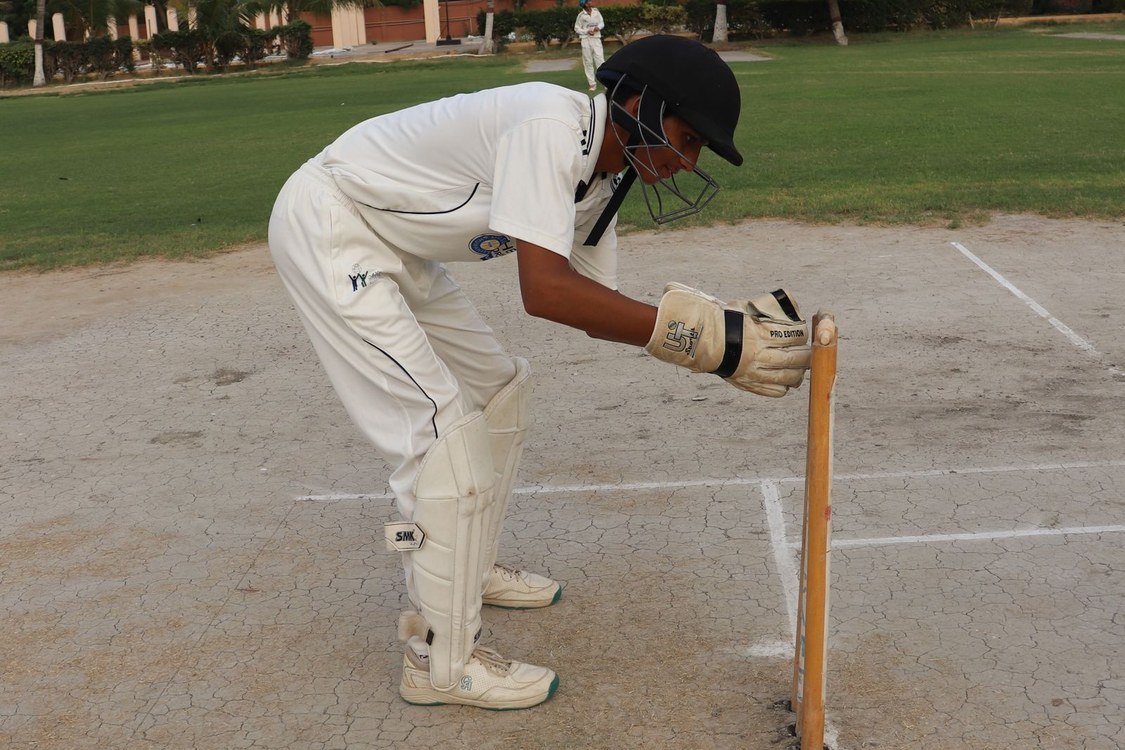
Nothing speeds up how to understand cricket like recognising the ways a batter can be dismissed, because a wicket is the event the whole match pivots on. There are five you will see regularly. Bowled: the bowler beats the bat and the ball hits the stumps. Caught: the batter hits the ball in the air and a fielder catches it before it bounces, the most common dismissal of all. Run out: while the batters are running between the ends, a fielder throws the ball and breaks the stumps before the runner arrives. Stumped: the wicketkeeper, the gloved fielder crouched behind the batter, collects the ball and breaks the stumps while the batter is out of their ground after stepping forward and missing. And then there is the famous one.
LBW stands for leg before wicket, and it confuses every beginner because the ball never touches the stumps. The idea is simple once someone says it plainly: if the ball hits the batter’s leg when it would otherwise have gone on to hit the stumps, the batter is not allowed to use their body as a shield, so they are out, provided a few conditions about where the ball pitched and where it struck are met. It is an umpire’s judgement call, which is why it produces the loudest appeals and the most arguments, and why televised internationals let teams review the decision and watch a ball tracking replay show where the ball was heading. The MCC, the club that has written the Laws of Cricket since 1787, publishes the full law book free on its site if you ever want the exact wording, but for watching purposes the shield idea is enough: legs are not a second bat. Do not let the extra conditions put you off, either. The working version of LBW above is the one most lifelong fans carry in their heads, and it is plenty for how to understand cricket on an ordinary evening.
Fielding Positions: Learn Six Names and Fake the Rest
Fielding positions are where guides on how to understand cricket often lose people, because there are dozens of names and they sound like a secret code: silly mid off, deep square leg, third man. Ignore almost all of them. Six names will carry you through any broadcast. The wicketkeeper stands behind the batter and takes the balls the batter misses. The slips stand just behind and beside the keeper, waiting for edges off the bat, like a goalkeeper’s reflexes tested sideways. Point and cover are the fielders on the batter’s hitting side, roughly square and in front, where a lot of shots travel. Mid off patrols in front on the opposite side, a busy spot for drives. Long on and long off are the two fielders posted right back at the boundary, there to stop fours and take the big catches. Six names, honestly held, will make almost any passage of commentary sound familiar, and familiarity is at least half of how to understand cricket.
Why learn even six? Because field placement is the visible half of tactics. Between balls, watch the captain move a fielder ten paces and ask yourself what shot he is trying to prevent or invite. When the field spreads out to the boundary, the bowling side is defending. When fielders crowd in close around the bat, they are attacking and expect a wicket soon. Reading the field is how to watch cricket like someone who has done it for years, and it costs you nothing but attention. It is also the part of how to understand cricket that no rule book can teach, because it is about intention rather than law.
What to Actually Watch During Your First Match
The practical side of how to understand cricket is knowing where to look between the obvious moments. Watch the duel, not just the ball. Every delivery is a small contest: the bowler trying to outthink one specific batter, the batter deciding whether this ball is for defending, leaving or attacking. When a batter survives a few quiet overs and then suddenly attacks, that change of gear is a decision, usually because the required rate is climbing or a weaker bowler has come on. Noticing those gear changes is the moment how to understand cricket stops being theory and becomes actually following a match. You will find more guides like this in our Entertainment section.
Watch the bowling changes too. Bowlers tire and captains rotate them, and in limited overs cricket no bowler can deliver more than a fifth of the overs, four in a T20 and ten in an ODI, so the captain is always budgeting his best bowlers for the moments that matter most, often the final overs. Following that arithmetic is an underrated pleasure of how to understand cricket, because it turns the quiet middle overs into visible decisions. Watch them as closely as the loud ones and you will find the match has far fewer dull patches than it first appeared to. Watch what the scoreboard is asking. A chase that needs eight runs an over is calm; the same chase at thirteen an over is a slow emergency, and you can feel the batting side’s risk taking rise ball by ball. And watch the crowd and the players for the wicket celebrations: in cricket, wickets are rarer and bigger than goals in most sports, and the noise tells you the size of the moment before the replay does.
Frequently Asked Questions
How long does a cricket match actually last?
It depends entirely on the format. A T20 match, 20 overs per side, is usually finished in about three hours. A One Day International, 50 overs per side, takes the best part of a day, roughly seven to eight hours with the break between innings. A Test match can run the full five days. Picking the format is picking the time commitment, which is why most advice on how to understand cricket starts beginners with a T20.
Why do the players shout “howzat” all the time?
It is a contraction of “how is that?”, and it is not just noise. A batter cannot be given out on most dismissals unless the fielding side appeals to the umpire, and the shout is that appeal. A big, unified appeal is also theatre: it tells the umpire, the crowd and everyone learning how to understand cricket that the bowling side believes a wicket has fallen.
What is a duck?
A duck is a batter dismissed without scoring a single run. The name is short for a duck’s egg, the shape of the zero on the scorecard beside their name. It is the fate every batter dreads and every beginner remembers, because it is the one piece of cricket terms explained by pure cruelty: you waited your turn, walked out, and walked back with nothing. It is also a small reminder that how to understand cricket includes learning its humour, because the game laughs at its own heroes regularly.
How can a match last five days and still end in a draw?
Because a Test match is limited by time rather than overs. If five days pass and neither side has completed the win, by bowling the other out twice or passing their total in the final innings, the match is drawn. That is different from a tie, where the scores finish exactly level. Draws frustrate newcomers and delight traditionalists, and accepting them is a late lesson in how to understand cricket: sometimes the contest itself is the result.
Is cricket just a complicated version of baseball?
They are distant cousins rather than versions of each other. Both involve a bat, a ball and running to score, but cricket has no foul territory, batters can hit all around the field, stay in after scoring, and are defended by the wickets behind them rather than by strikes. If you know baseball, the fastest route into how does cricket work is to drop the comparisons after the first hour and let cricket be its own shape. After that, the rest of how to understand cricket is simply practice in watching, and it accumulates faster than you expect.
The Short Version
How to understand cricket comes down to one sentence and three words. The sentence: two teams take turns batting and bowling, and the side with more runs wins. The three words: runs are the points, scored by running between the ends or hitting fours and sixes to the boundary; wickets are batters getting out, and ten of them end an innings; overs are sets of six balls that ration the match, 20 a side in a T20, 50 in an ODI, and unlimited across five days in a Test. Read the corner graphic as runs, wickets, overs, learn the six fielding names that matter, and let one T20 teach you the rhythm before you attempt anything longer. Do those things in that order and how to understand cricket largely takes care of itself.
This is the first article in our Entertainment section, and you can browse everything else we publish on the Blog page.

Written by Ayesha Khan
Ayesha is Burry Blog’s senior editor. She writes about digital marketing, SEO and online publishing, and leads the site’s website reviews, checking what a platform really offers before explaining how to use it.