

Almost everyone who has tried running has the same first run story. New shoes, out of the front door, off down the road at a pace that feels fine for about ninety seconds. Then the breathing goes ragged, the legs turn heavy, and the run ends as a walk home and a private verdict: running is not for me. That verdict is usually wrong. The problem is almost never fitness, and it is not willpower either. It is that nobody explained how to start running at a level a beginner’s body can actually handle on day one.
This guide is that explanation. It follows the method behind the NHS Couch to 5K, the free beginner running plan the NHS publishes for people who have done little or no running. The whole plan runs for nine weeks, but the part that decides whether you stick with it is the first month, so that is where this article spends its time: how to start running in week one, what changes in weeks two to four, and what is waiting in week five. If you only remember one sentence, make it this one. How to start running is mostly about starting slowly enough that you are still doing it in month two.
Key Points
- Start with walking breaks — one minute runs at first — because heart and lungs adapt faster than tendons and joints.
- Run three times a week with a rest day between runs; rest is half the training.
- Keep the pace slow enough to hold a conversation — the talk test.
- The only gear that matters is supportive running shoes.
- Check with a GP first if you have a health condition or any worry.
- Repeat any week that beats you; the plan can take nine weeks or longer.
In This Guide
- Before Your First Run, a Short Health Check
- Why the Walking Breaks Are the Method, Not a Failure
- Gear: the One Purchase That Matters
- Your First Four Weeks, Session by Session
- The Pace Rule That Saves More Beginners Than Any Other
- Rest Days, Soreness, and Knowing the Difference
- Week Five, and the First Twenty Minutes
- Frequently Asked Questions
- The Bottom Line
Before Your First Run, a Short Health Check
Running is a vigorous exercise, and honest advice on how to start running begins with a caution rather than a training tip. The NHS advises speaking to a GP first if you are worried about your health before starting an exercise plan like Couch to 5K. Take that seriously if you live with a heart condition, asthma, diabetes, joint problems or high blood pressure, if you are recovering from an illness or an injury, or if you have not exercised in years and simply feel unsure. One appointment is not a barrier to starting. It is how to start running safely, and it turns guesswork into a clear yes.
Two rules then apply to every session in this guide. First, the NHS plan itself says to listen to your body and stop if something does not feel right. Second, some feelings are stop signals, not toughness tests. Chest pain or tightness, dizziness, feeling faint, or a sharp pain anywhere means stop, walk, and get medical advice before you run again. Breathlessness that settles when you walk is normal in week one. Pain that changes how you move is not. The NHS also advises against starting a new vigorous activity during pregnancy, so that is a conversation for a midwife or GP rather than a running plan. None of this is meant to put you off. It is the short list that keeps a healthy habit healthy.
Why the Walking Breaks Are the Method, Not a Failure
The single most useful idea in how to start running for beginners is that you do not start by running. You start by alternating short runs with walking breaks, and the walking is a planned part of the training, not what happens when the training goes wrong.
There are two reasons this works. The first is that your heart and lungs adapt faster than the rest of you. Within a couple of weeks your breathing will feel easier, but tendons, joints and bones strengthen more slowly. They are what complain when a keen beginner does too much too soon. Walking intervals keep the total load in the range where your body adapts instead of breaking down. Every honest guide on how to start running comes back to this sooner or later: the walk breaks are what make the running possible. The second reason is simpler. A session built from one minute runs is finishable on a bad day, in bad weather, on tired legs. Finishing sessions is what builds the habit, and the habit is what builds the runner.
This is not a watered down version of real training. The couch to 5k plan was created by a runner called Josh Clark who wanted to help his mum get off the couch and get active, and its whole design is aimed at people starting from nothing. If you are wondering how to start running when out of shape, this is the answer the NHS settled on: mostly walking at first, with the running folded in a minute at a time.
Gear: the One Purchase That Matters
Beginners often ask about kit before they ask how to start running, and the honest list is short. The one item that genuinely matters is your shoes. You want running shoes that support your feet and feel comfortable from the first step, with no rubbing and no pinched toes. Running in worn out trainers with flattened soles is the classic false economy, because your feet and shins absorb everything the shoe no longer does. If you buy one thing before you start running today, buy the shoes.
Everything else is probably already in your house. Wear clothes that are comfortable to move in, and a supportive bra if you need one. Take a water bottle, especially in warm weather, and take small sips when you want them. You need a way to time the intervals, which can be a watch, a phone timer, or the free NHS Couch to 5K app, which times each run and walk for you and talks you through the session while your own music plays. A light snack an hour or two before you run, something like a banana or a slice of toast, is the NHS suggestion if you run hungry. If you will be running in the dark, wear reflective clothing, choose well lit routes, and stay aware of your surroundings, particularly if you wear headphones. That is the complete list. Expensive kit has never been the answer to how to start running. A sound pair of shoes and a plan are. No special watch, no technical clothing, no supplements stand between you and week one.

How to Start Running: Your First Four Weeks, Session by Session
Here is the beginner running plan itself, the practical core of how to start running, following the NHS weeks exactly. You run three times a week, and you take a rest day between runs, so Monday, Wednesday and Friday is the classic pattern. Every session has the same frame: a brisk 5 minute walk to warm up, the intervals in the middle, and a 5 minute walk to cool down at the end. The NHS also suggests gentle stretches before and after, which help your muscles and joints move through their full range and recover afterwards. The session is the same all three times in a given week, and that repetition is deliberate, because the second and third attempts are where a week starts to feel like yours. Repetition, not novelty, is the engine of how to start running. This plan is part of our Sports section.
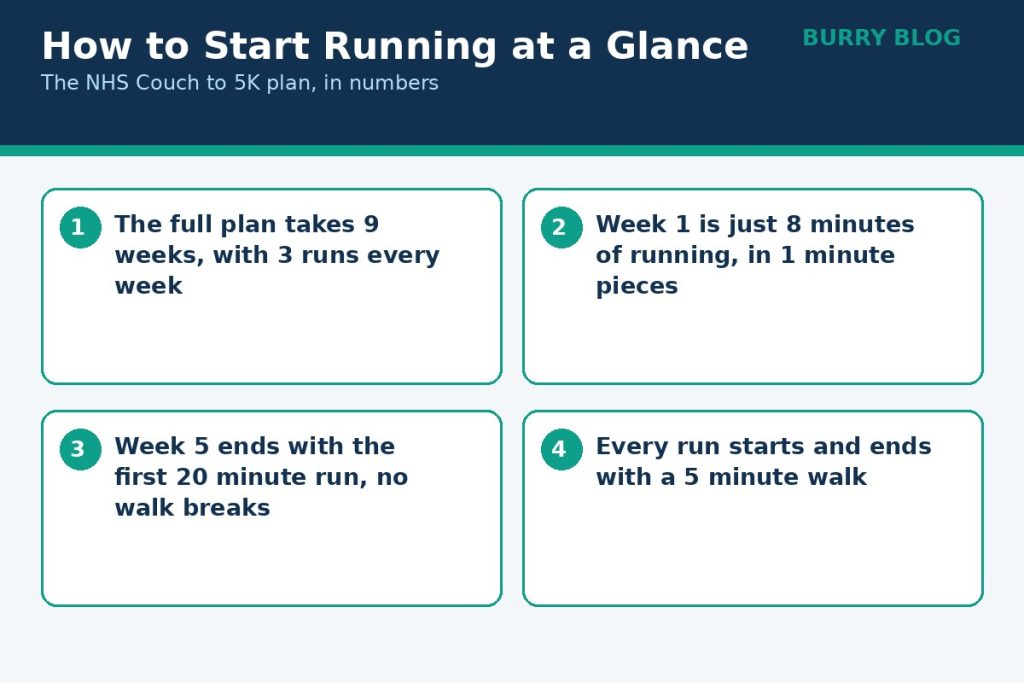
Week 1. Run for 1 minute, walk for 1 minute 30 seconds, and repeat that pattern until you have run 8 times, for 8 minutes of running in total. The whole session takes a little under half an hour including the walks. By the third session it may feel almost too easy. That feeling is the plan working, not a sign to skip ahead, because week 1 exists to teach your legs the motion and your diary the habit.
Week 2. The runs stretch slightly: run for 1 minute 30 seconds, walk for 2 minutes, repeated until you have run 6 times, for 9 minutes of running in total. The longer walks balance the longer runs, so the session feels much like week 1 with a little more in it. Focus on keeping the pace steady and your shoulders relaxed rather than covering more ground. This is how to start running without drama: small increases, honestly repeated.
Week 3. Now the shape changes. Run 1 minute 30 seconds, walk 1 minute 30 seconds, run 3 minutes, walk 3 minutes, then repeat the whole sequence once more. You still run for 9 minutes in total, but half of it now comes in two 3 minute blocks, and those blocks are the point of the week. The first 3 minute run teaches most beginners more about pacing than anything in week 1, because a pace that survives three minutes is a very different pace from one that survives one. If you take a single lesson about how to start running from the whole month, take it from this week: duration is built by patience, not by effort.
Week 4. This is the build week, the point where how to start running turns into recognisable training: run 3 minutes, walk 1 minute 30 seconds, run 5 minutes, walk 2 minutes 30 seconds, run 3 minutes, walk 1 minute 30 seconds, and finish with a run of 5 minutes. That is 16 minutes of running, nearly double week 3, and it is normal for the first session of week 4 to feel like a step up. The NHS tip for this week is worth borrowing: match your breathing to your stride, breathing in for 3 steps and out for 2, and keep your head up and your back straight. If a week defeats you, repeat it and move on when you have finished it. The plan can take nine weeks or longer, and nobody awards marks for finishing on schedule.

The First Weeks at a Glance
| Week | What the running looks like |
|---|---|
| Week 1 | Run 1 minute, walk 1 minute 30 seconds, repeat until you have run 8 times, 8 minutes of running in total |
| Week 2 | Run 1 minute 30 seconds, walk 2 minutes, repeated until you have run 6 times, 9 minutes of running in total |
| Week 3 | Run 1 minute 30 seconds, walk 1 minute 30 seconds, run 3 minutes, walk 3 minutes, repeat the whole sequence once more, 9 minutes of running in total |
| Week 4 | Run 3 minutes, walk 1 minute 30 seconds, run 5 minutes, walk 2 minutes 30 seconds, run 3 minutes, walk 1 minute 30 seconds, finish with a run of 5 minutes, 16 minutes of running in total |
| Week 5 | First session has 5 minute runs, second session has two runs of 8 minutes, third session is a run of 20 minutes |
| Week 9 | Running for 30 minutes |
The Pace Rule That Saves More Beginners Than Any Other
Of all the running tips for beginners, one does more work than the rest combined, and it answers how to start running better than any training gadget: run at a pace where you can still talk. If you can speak in short sentences while you run, your pace is right for this plan. If you can only gasp single words, you are going too fast, so slow down, even if slowing down feels like barely more than a shuffle. A shuffle you can sustain for 3 minutes teaches your body more than a sprint you abandon in one.
This matters because beginners almost always run too fast. They run at the speed running looks like in films, and their bodies file the experience under threat rather than training. The plan measures your progress in minutes, not in distance or speed, and that is a deliberate choice. Speed arrives on its own later, as a side effect of fitness. In your first month, the only question that counts is whether you finished the session at a pace you could have kept going at for a little longer. Learning how to start running is, in large part, learning to hold back.
Rest Days, Soreness, and Knowing the Difference
The rest day between runs is not a gap in the plan. The NHS is blunt about this: rest days give your body time to recover, help prevent injury, and are just as important as the runs themselves. Adaptation happens between sessions, when the small stresses of a run are repaired and the body comes back slightly stronger. Running every day in week 2 does not speed that up. It interrupts it, and it is the fastest route to the shin pain and sore knees that end beginner running plans. Gentle walking on a rest day is fine and often helps. A second run is not a rest day activity. Rest is not the absence of training in any serious account of how to start running. It is half of the training.
Expect some soreness, and learn to read it, because reading your own signals is part of how to start running well and not an optional extra. Stiff, achy thighs a day or two after your early sessions are normal muscle soreness, and they fade as the weeks repeat. Sleep is part of that repair work, which is why tired beginners often find their legs feel heavier after short nights; our guide to how to sleep better covers the habits that help if your rest days are not feeling very restful. Pain is different from soreness. A sharp pain, pain in one specific spot, pain that makes you limp or change how you run, swelling, or anything in your chest belongs in the stop category from the health section above: end the session, rest, and get it checked if it does not settle. The beginners who learn to run successfully are rarely the toughest. They are the ones who treat pain as information instead of a challenge.
Week Five, and the First Twenty Minutes
If the first four weeks go to plan, week five is where the shape of the thing changes, and it is worth knowing what is coming. The first session of week 5 uses 5 minute runs with walking breaks. The second moves to two runs of 8 minutes. The third session drops the walking breaks from the middle altogether and asks you to run for 20 minutes between your warm up and cool down walks. For most people that 20 minute run is the emotional summit of the whole plan, the moment running for beginners stops feeling like an experiment.
Twenty minutes sounds like a cliff edge after a month of intervals, but by then you have twelve sessions behind you, including 5 minute and 8 minute blocks, and your body has been preparing for exactly this since week 1. From there the remaining weeks build towards running for 30 minutes in week 9, which is the plan’s finish line: 30 minutes of running, at your pace, whatever distance that turns out to be. After that, plenty of people simply keep running three times a week, and the NHS suggests parkrun, the free weekly 5km events where walking, jogging and running are all normal, as a friendly next step. And if week five, or any week, goes badly, the standing rule still applies: repeat it. That patience is the thread running through every part of how to start running, from the first walking break to the last rest day. A beginner runner who takes eleven weeks has still done the whole thing. You can browse everything else we publish on the Blog page.
Frequently Asked Questions
How long will it take before I can run 5K?
The full couch to 5k plan runs for nine weeks and ends with you running for 30 minutes without stopping. Whether 30 minutes is exactly 5 kilometres depends on your pace, and for many beginners it is a little less at first, which is fine. The plan is built around time, not distance, and it can take nine weeks or longer. Knowing how to start running patiently matters more than hitting a distance on a deadline.
Can I start running if I am overweight or have not exercised in years?
That is exactly who this plan was designed for. It begins with one minute runs inside a mostly walking session, and it assumes little or no recent exercise. Wear supportive shoes, keep the pace at talking level, and follow the health guidance above: if you have a medical condition or any worry about your health, speak to a GP before your first session. Starting gently is not a lesser version of how to start running. It is the version that works.
Do I need to run every day to improve?
No, and you should not. The plan for how to start running is three sessions a week with a rest day between each one, because recovery is when your body adapts and gets stronger. Extra rest days are always allowed. Extra runs in the first month usually buy soreness rather than progress.
What should I do if a week feels too hard to finish?
Slow down first, because pace is the most common problem, and managing pace is the oldest lesson in how to start running. If you still cannot finish a session, repeat the whole week until you can. The NHS plan is designed to be repeated, and finishing week 3 twice is a better foundation than struggling through week 4 once. Repeating a week is the standard move in any beginner running plan, not a sign that you have failed at it.
Can I follow the plan on a treadmill?
Yes. The NHS says the runs can be done on a treadmill if running outside does not suit you. Keep the same structure, the warm up and cool down walks, the same intervals, and the same easy pace. A slight incline is sometimes used to mimic outdoor running, but it is optional. What matters is the pattern of runs, walks and rest days, wherever you do them, because that pattern is how to start running in the first place.
The Bottom Line
Strip away the apps, the gear lists and the arguments about technique, and how to start running comes down to four things. Check with a GP first if your health gives you any reason to. Run slowly enough to talk, in short intervals with walking breaks, three times a week. Guard the rest days as carefully as the runs. And repeat any week that beats you, without treating it as a verdict. Do that, and your first four weeks will carry you from one minute runs to five minute runs, with a 20 minute run waiting in week five and a habit that has a real chance of surviving the year. You now know how to start running. The only step left is the first one minute run.
This is the first article in our Sports section, and you can browse everything else we publish on the Blog page.

Written by Fatima Noor
Fatima writes education, lifestyle and how-to guides for Burry Blog readers. Her focus is clear steps and practical detail: the things readers actually need to get something done.