

Working from home sounds like freedom until the first Tuesday. The commute is gone, nobody walks past your desk, and the whole house is within reach: the fridge, the laundry, the phone, the television. The work is the same, but the structure that used to hold it up is missing, and focus is usually the first thing to go.
The fix is not more willpower. The people who stay focused at home do not have stronger discipline. They have a setup that makes focus the easy option: one place to work, one task at a time, a clock that decides when to stop, and a finish time that is not negotiable. This guide follows the guidance of Atlassian, HubSpot and the Mayo Clinic, and it puts the pieces together in an order you can copy tomorrow. More practical guides like this one live in our Technology section.
Key Points
- Focus at home is a system, not willpower: one place, one task, a clock, a finish time.
- Five blocks repeat every day: start, deep work, admin, reset, shutdown.
- Only about 2 percent of people multitask well; mono-tasking wins.
- Make distractions hard to reach and breaks real, with a walk and daylight.
- Plan tomorrow tonight, and end the day with a shutdown ritual.
In This Guide
- The Real Problem Is Not Laziness
- How to Stay Focused While Working From Home in Five Blocks
- Give Your Work One Place to Live
- One Thing at a Time, On Purpose
- Make Distractions Harder to Reach
- Work in Sprints, Then Actually Stop
- The Night Before Decides the Morning
- End the Day Like You Mean It
- When Your Head Will Not Settle
- Frequently Asked Questions
The Real Problem Is Not Laziness
When focus slips at home, the usual explanation is laziness, and it is usually wrong. An office gives you a dozen small structures for free: a start time set by the commute, a desk that belongs to work, colleagues who notice when you disappear, and an end of day when everyone packs up. At home, none of that exists unless you build it. A study Atlassian cites, conducted by Paper Giant, found that 40 percent of remote workers felt working from home translated to significantly longer hours. Longer hours with worse focus is the signature of a missing system, not a missing work ethic.
That is good news, because a system can be built in an evening. The rest of this guide is that system, in five blocks that repeat every day.
How to Stay Focused While Working From Home in Five Blocks
A workday that runs on decisions will fall apart by mid-morning, because every hour asks you to choose what to do next. A workday that runs on blocks does not ask. You decide the blocks once, then just follow them. Here is the shape that works for most people, built from the advice below.
| Block | What to do | What it stops |
|---|---|---|
| Start block, 15 minutes | Check the plan made last night, pick the first task, clear the desk | Starting the day by reacting to email and messages |
| Deep-work block, 90 minutes | One hard task, phone away, notifications off | Half-finished work and constant switching |
| Admin block, 30 minutes | Email, messages, small jobs, calls | Small tasks stealing the best hours |
| Reset block, 15 minutes | Walk, stretch, water, daylight, no screen | The afternoon slump and the third coffee |
| Shutdown block, 10 minutes | Write tomorrow’s first task, close everything, leave the desk | Work leaking into the evening |
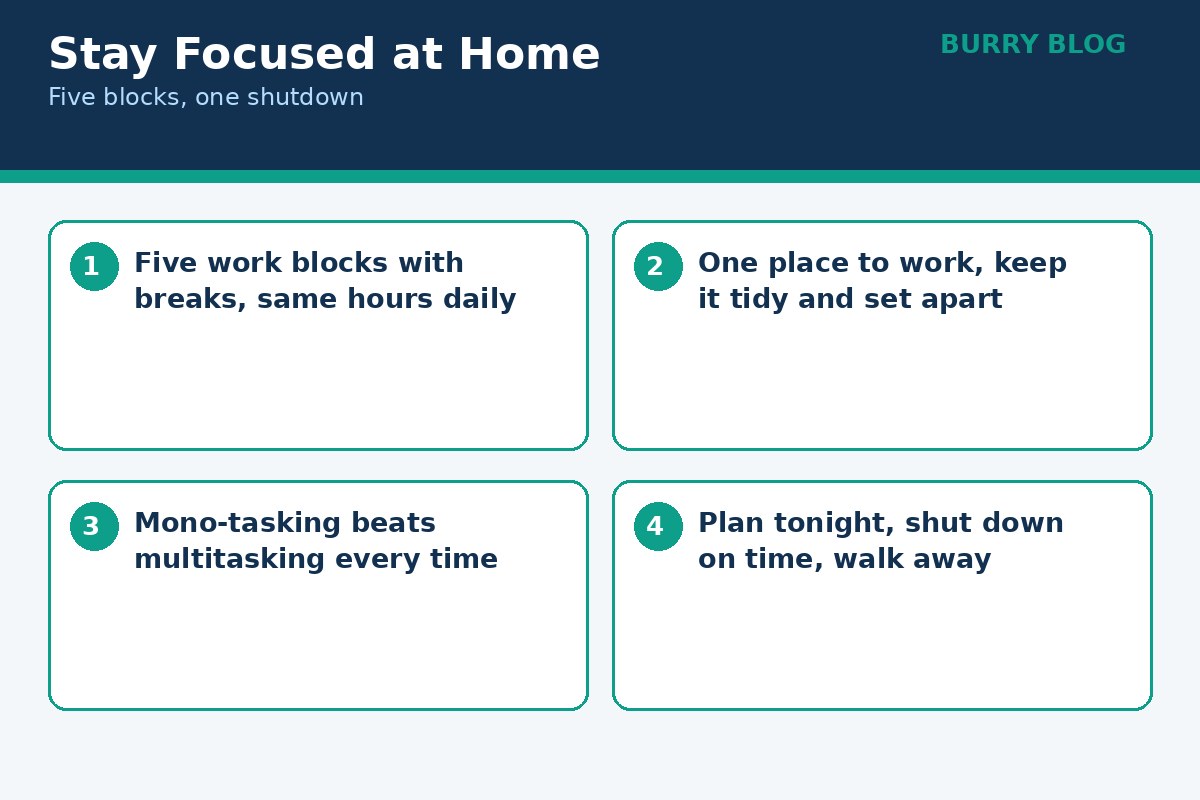
The times are a starting point, not a law. If your best hours are late morning, put the deep-work block there. If you have calls all afternoon, move the admin block to match. What matters is that the blocks exist and repeat, so the day has a shape before it starts.
Give Your Work One Place to Live
The single most useful change is a place that belongs to work and nothing else. Atlassian calls this desk-scaping, and the Paper Giant study behind it found that 49 percent of workers felt they needed a better working space, with more than a third saying their workspace was less comfortable than the office. A separate corner of a room counts. A kitchen table that gets cleared and set up the same way every morning counts. What does not work is floating from sofa to bed to counter, because your brain never gets the signal that work has started.
Keep the space simple. Atlassian suggests zoning: one spot for reference material, one for supplies, one for long-term projects, and a clear desk with only what the day needs. Clutter is not just untidy. Research published in the Journal of Neuroscience, cited by Atlassian, found that clutter limits the brain’s ability to process information. A clear desk is not a personality trait. It is a focus tool.
One Thing at a Time, On Purpose
Multitasking feels productive and is mostly an illusion. Atlassian cites Professor David Strayer of the University of Utah, an expert in cognitive distraction, who puts the share of people who can multitask efficiently at roughly 2 percent of the population. Everyone else who bounces between tasks is not doing more. They are forcing their brain to switch speeds constantly, steering through tasks more erratically and burning out faster.
The fix is mono-tasking: one task, one block, until it is done or the timer ends. Business coach Ryan Jackson, quoted by Atlassian, suggests devoting days or half-days to themes or closely related tasks, so that even if you do get distracted, it is quicker to pick up the thread again. If your work is a mix of writing, calls and admin, give each its own block instead of mixing all three into every hour.
Make Distractions Harder to Reach
Willpower loses to convenience every time, so the smart move is to make distractions inconvenient. Atlassian suggests a not-to-do list kept permanently in view: social media, cat videos, the sink full of dishes, whatever pulls you away. Writing down what you will not do during work hours is a reminder, and blocking the sites outright is stronger still. Tools like RescueTime, LeechBlock and SelfControl, named by Atlassian, can prevent access to selected websites during set hours.
HubSpot’s advice is the same idea from the other side: make social media harder to open. Remove the apps from your browser shortcuts, log out of every account on your phone and computer, and shut off notifications during work hours. Working in a private browser window keeps you signed out, so every search stops autocompleting your favourite time sinks. One HubSpot contributor removes all social networks from the toolbar bookmarks entirely, because the gateway is what pulls you in.
People in the house need a signal too. HubSpot quotes a remote worker who uses headphones as the sign: when the headphones are on, he is working, even if it looks like he is just sitting at home. Agree the signal and quiet times with anyone who shares the house.
Work in Sprints, Then Actually Stop
Focus is a stamina problem as much as a discipline problem. Atlassian’s advice is to pair the Pareto Principle with Pomodoros: identify the 20 percent of your work that produces 80 percent of the results, then spend your best minutes on that 20 percent in 25-minute sprints, each followed by a five-minute break. HubSpot’s version is the same shape: set a 25-minute timer, pick one task you can finish in that time, clear the distractions, and stop when the timer beeps. The timer creates urgency, so a single task cannot stretch to fill the whole morning.
Find your flow time and protect it. Atlassian describes flow as a period of hyper-focus when you work most smoothly, and suggests blocking 90 minutes in that window each day for deep work on your biggest tasks, with no rings or pings to break it. For some people that is early morning, for others the afternoon. Save your hardest tasks for that window and use the slower hours for the easy logistical jobs.
Breaks have to be real breaks. HubSpot found that many remote workers skip lunch or work straight through it, and the fix is to put breaks on the calendar like meetings: a walk, fresh air, time near natural light, time with another person. A five to ten minute walk away from the desk does more for the next hour than another coffee. HubSpot’s Nick Congelosi uses fixed stopping points through the day, at 10:30, noon, 3:30 and 5:30, and takes them unless something is genuinely mission critical.

The Night Before Decides the Morning
The cheapest focus tool in this guide takes ten minutes and happens the night before. Atlassian’s advice is to spend the final ten minutes of your workday, while you are still in work mode, writing tomorrow’s list. A task that takes ten minutes tonight can take twice as long when you come to it cold in the morning. Keep the list short, and sort it with the Urgent-Important Matrix, also called the Eisenhower Matrix, which organises tasks into four quadrants by urgency and importance, so the urgent and important work goes first and the rest gets scheduled, delegated or dropped. HubSpot says the same thing from the other side: plan out what you will work on ahead of time, and solidify the schedule the day before, so it feels official when you wake up.
Mornings need a start ritual too. Atlassian suggests dressing as if you were going to the office, not formally, but enough that your brain gets the message that it is game time. HubSpot says the same: get fully ready for the day and pretend you are actually going to work, or you may find yourself back in bed. A shower, real clothes, coffee, a short review of the list, and then the first block starts at the same time every day.
End the Day Like You Mean It
The hardest part of working from home is not starting. It is stopping. Atlassian calls for a firm finish time, a force quit to the workday, and warns that overworking leads to stress and burnout, harming productivity and mental health. If you struggle to stop, find an accountability partner, a colleague, friend or manager, and set up a call to officially end the day. HubSpot’s version is to make plans immediately after work, so the day has a hard cutoff: a firm deadline forces the important tasks to get done faster, and it protects the evening from work creep.
The shutdown ritual is simple: write tomorrow’s first task, close every tab and app, put the laptop away, and leave the workspace. When the desk is closed, the day is closed. That boundary is also what protects your sleep, and sleep is what protects tomorrow’s focus. A tired brain cannot mono-task, no matter how good the system is, and our guide on how to sleep better covers the evening half of that deal.
If work still follows you into the evening, check the obvious leak: notifications on your phone. Turn them off after your finish time. The work will still be there in the morning, in its block, where it belongs.
When Your Head Will Not Settle
Some days the problem is not the setup, it is the state of your head. The Mayo Clinic’s guidance on stress management starts with naming the trigger: what makes you feel tense, worried or irritable, and whether it is hard to focus or sleep. Once you know the trigger, you can deal with what you can control and change your reaction to the rest. Managing time and prioritising tasks is part of it, and so is saying no to commitments that are not important.
The Clinic’s relaxation techniques are simple and short: deep breathing, meditation, mindfulness, focusing on the present, or a walk outside. They slow your breathing and focus your attention, and regular physical activity works the same way. When your head will not settle, a five-minute breathing break or a ten-minute walk is not lost work time. It is the reset that makes the next sprint possible. If focus problems persist for weeks, or come with low mood or constant worry, that is a conversation for a doctor, not a productivity system.

Frequently Asked Questions
How many hours a day should I work from home?
There is no number that fits everyone. What matters is that the hours are set in advance and end at a fixed time. Atlassian’s research found many remote workers felt their hours had grown longer at home, so a firm finish time matters more than a long day.
Is multitasking ever a good idea when working from home?
Almost never. Only about 2 percent of people can multitask efficiently, according to research cited by Atlassian. For everyone else, one task at a time, in timed blocks, gets more done with less strain.
What is the Pomodoro technique, exactly?
Work in 25-minute sprints on a single task, then take a five-minute break, and repeat. The timer creates urgency and guarantees a break, which is why both Atlassian and HubSpot recommend it for remote work.
How do I stop work from taking over my evenings?
Set a firm finish time and a shutdown ritual: write tomorrow’s first task, close everything, and leave the workspace. Making plans right after work gives the day a hard cutoff, and turning off work notifications after hours keeps the boundary in place.
What if I cannot concentrate even with a good setup?
Check the basics first: sleep, movement, and stress. The Mayo Clinic suggests identifying what is causing the stress and using short relaxation techniques like deep breathing or a walk. If poor focus lasts for weeks, talk to a doctor.

Written by Fatima Noor
Fatima writes education, lifestyle and how-to guides for Burry Blog readers. Her focus is clear steps and practical detail: the things readers actually need to get something done.