

Most people do not overspend because they are careless. They overspend because they never look. Money leaves the account in small amounts, a coffee here, a delivery there, a subscription that renews quietly, and by the end of the month the total is a surprise. The fix is not a complicated app or a strict diet of no spending at all. It is a short, regular look at where the money went, done often enough that nothing hides for long. More practical money guides like this one live in our Finance section.
Key Points
- A 15-minute weekly review beats a monthly budget, because problems are caught while there is still time to fix them.
- Start with one honest month of real numbers, including a miscellaneous category for the out of the ordinary.
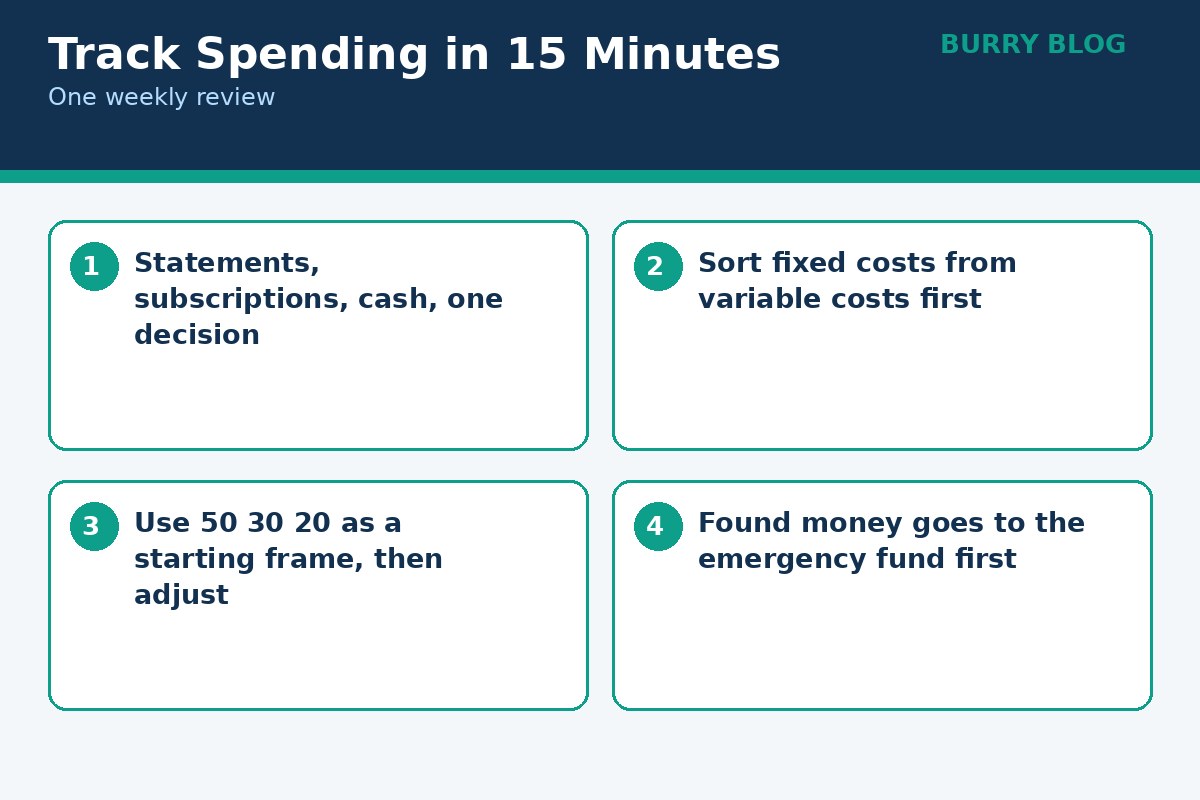
- Four steps each week: read statements, sort into categories, check for surprises, decide one small thing.
- Use the 50/30/20 frame as a starting point, and sort fixed wants honestly.
- Subscription creep is the quietest leak; found money goes to the emergency fund first.
In This Guide
- Why Fifteen Minutes Is Enough
- Start With One Honest Month
- How to Track Your Monthly Spending: The 15-Minute Weekly Review
- The 50/30/20 Frame: A Map, Not a Law
- Fixed, Variable, and the Ones That Pretend to Be Fixed
- Three Ways to Keep the Record: Notebook, Spreadsheet, App
- Subscription Creep: The Quiet Leak
- When a Category Overshoots
- What to Do With the Money You Find
- Frequently Asked Questions
Why Fifteen Minutes Is Enough
A monthly budget fails for a boring reason: the gap between checks is too long. If you only look once a month, you find the problem after the money is gone. A weekly check catches it while there is still time to change the next three weeks. A takeaway habit spotted in week one costs one week of takeaways; spotted on the 30th, it costs a month of them.
Fifteen minutes works because the job is small. You are not building a budget from scratch each week. You are checking three things: what came in, what went out, and whether anything looks wrong. The Consumer Financial Protection Bureau makes the same point: start small and look at your expenses one week at a time, by reviewing your receipts or your checking account. A daily log is another option the Bureau suggests, mainly because it catches the small purchases that add up, like buying breakfast or lunch instead of bringing it with you.
Start With One Honest Month
Before the weekly review can work, you need a baseline: one month of real numbers, not guesses. The Consumer Financial Protection Bureau calls logging your spending the heaviest lift in budgeting, and the most important one. Its Spending Tracker is built for exactly this job: collect every receipt for a month, write down what each one was for, and add up the totals per category each week. If a whole month feels like too much, the Bureau says to try one or two weeks instead.
The trick is to record what you actually spent, not what you think you should have spent. The Bureau’s “Assess your spending” guidance warns against editing your numbers to reflect what you could or should be spending. The first month is a photograph, not a report card.
Two details make the baseline much more accurate. First, look back over several months, not just one, because one month can miss irregular costs such as car registration or annual subscriptions. The Bureau suggests dividing yearly costs by 12 and including them as a monthly line. Second, include a miscellaneous category for the out of the ordinary, a brake replacement or plane tickets for a best friend’s wedding.

How to Track Your Monthly Spending: The 15-Minute Weekly Review
Here is the routine, in order. Set a timer for fifteen minutes and work through four steps.
Step one, two minutes: open your bank and card statements for the week and read every transaction. Anything you do not recognise gets a mark. NerdWallet‘s weekly checklist starts the same way: log your spending, look at recent transactions, and write down cash purchases.
Step two, five minutes: sort the week’s spending into your categories and add the numbers to your running monthly totals. Keep the category list short, six or seven at most. A list of twenty categories is a list you will stop using.
Step three, five minutes: check for surprises. NerdWallet’s weekly checklist says to be on the lookout for double charges, price increases on subscriptions, or anything else unusual. A streaming service that went up by two dollars, a free trial that turned into a paid plan, a delivery fee you did not notice. The Consumer Financial Protection Bureau asks the same question: are there service fees on your credit card that you could eliminate?
Step four, three minutes: decide one small thing for next week. Not five things, one. Cancel one subscription, set one limit, move one amount to savings. NerdWallet’s next step is the same idea: make one small change this week, such as pausing an unused subscription or moving $25 into savings.
When the timer ends, stop. The habit survives because it ends on time.
The 50/30/20 Frame: A Map, Not a Law
Once you know what you spend, you need a way to judge it. The simplest frame is the 50/30/20 rule, which NerdWallet recommends as a starting point. Divide your monthly take-home pay into three buckets: 50 percent for needs, 30 percent for wants, and 20 percent for savings and debt repayment.
Two warnings come with the frame. First, a cost does not become a necessity just because it is a recurring bill. NerdWallet gives the example directly: a streaming subscription is a fixed want, while groceries are a variable need. Sorting honestly is the whole exercise. Second, you do not have to match the percentages exactly. NerdWallet says you can adjust them to fit your circumstances, and if your needs go over 50 percent month after month, it suggests considering a different model altogether, such as a 60/20/20 split.
| Category | What counts here | How to check it |
|---|---|---|
| Housing | Rent or mortgage, utilities, insurance | Fixed bills, check the statement amount each month |
| Groceries | Food and household supplies | Weekly shop total, compare with the past three months |
| Transport | Fuel, fares, parking, car costs | Card transactions plus cash spent on the road |
| Subscriptions | Streaming, apps, memberships, cloud storage | The subscription list, checked every week for price rises |
| Eating out | Takeaways, cafes, delivery apps | Card transactions, the easiest category to underestimate |
| Debt and savings | Loan payments, emergency fund, savings goals | Amounts moved on payday, check they actually went through |
| Miscellaneous | Gifts, repairs, medical costs, one-offs | The catch-all, reviewed monthly so it never hides a leak |
Fixed, Variable, and the Ones That Pretend to Be Fixed
Sorting your spending into fixed and variable costs makes the weekly review faster, because you know which numbers should never change and which ones need watching. Fixed expenses generally stay the same each month: rent or mortgage, cell phone bill, insurance premiums, car payment. Variable costs change with your spending and usage: grocery costs, dining out, gas, your credit card bill.
For variable costs, NerdWallet suggests reviewing your transactions from the past three months to see what you typically spend. One month is too noisy: a holiday month makes groceries look huge, a quiet month makes them look tiny. Three months gives you a normal range, and the weekly review tells you whether this month is inside it.
Three Ways to Keep the Record: Notebook, Spreadsheet, App
There is no best tracking method, only the one you will keep using. The Washington Department of Financial Institutions lists four options: record every purchase in a small notebook, collect receipts and record them later, review your account statements at the end of each month, or use an app.
A notebook is the simplest. The Consumer Financial Protection Bureau’s spending tracker works the same way: a small container or envelope for receipts, and a few seconds to write on each receipt what you actually bought. At the end of the week, add up the totals per category. The Bureau notes that once people track their spending, many find money to save for emergencies, unexpected expenses and goals.
A spreadsheet suits people who like to see the numbers add up. One sheet, one row per category, one column per week, and a running total. Keep it to one page, or updating it becomes a chore of its own.
An app suits people who pay by card for almost everything. The app pulls the transactions in and sorts them, which saves the typing. The trade off is that cash disappears from the picture, and the app’s categories are rarely yours. Whichever method you pick, the weekly review is the same: statements, subscriptions, cash, one decision.

Subscription Creep: The Quiet Leak
Subscriptions are the most common leak the weekly review finds, because they are designed to be forgotten. A free trial ends, a yearly plan renews, a service raises its price by a dollar or two, and none of it asks your permission. NerdWallet’s quarterly checklist includes a subscription review for exactly this reason: cancel, pause or downgrade anything you are not using.
A practical trick is to keep a subscription list with the price and the renewal date next to each entry. When a price rises, the list shows it immediately, and you can decide before the next charge. The Consumer Financial Protection Bureau asks the same question in its tracker: are you paying for services or subscriptions that you are not really using?
When a Category Overshoots
Every category overshoots sometimes. The point of tracking is not to prevent that, it is to notice it early and decide what to do. If you came under budget in one area, NerdWallet’s monthly checklist says you can move the extra funds to another category or to savings. The reverse works the same way: if groceries ran over because you hosted family, take the extra from the wants bucket, not from savings. A budget that bends is a budget you keep.
There are three honest reasons a category overshoots, and each one needs a different response. A one-off event, such as a car repair or a wedding gift, is not a pattern; cover it from miscellaneous and move on. A price rise, such as higher utility bills in winter, is a new normal; update the category amount so next month’s comparison is fair. A habit, such as takeaways three nights a week, is the only one that needs a behaviour change, and the change should be small: cook twice a week instead of never, or set a takeaway night instead of banning them outright.
If the same category overshoots three months in a row, stop treating it as an accident. NerdWallet’s quarterly checklist says to look for spending patterns and ask which categories go over budget every month. A category that always overshoots is telling you the budget amount is wrong. Raise the amount and lower a want to match.
What to Do With the Money You Find
Tracking usually finds money. The Consumer Financial Protection Bureau says that once people track their spending, many can find money to save for emergencies, unexpected expenses and goals. The question is what to do with it before it gets spent again.
The first call on found money is an emergency fund. NerdWallet suggests starting an emergency fund of at least $500, which could be enough to cover small emergencies and repairs. Our guide on building an emergency fund on a small salary walks through the same idea in detail, starting from a very small amount and building it up month by month.
The second call is debt beyond the minimums. The 50/30/20 frame puts extra debt payments in the same 20 percent bucket as savings, and the order between them depends on the interest rate. High interest card debt usually comes first, because it grows faster than savings do.
The third call is the future: a sinking fund for the costs you know are coming. NerdWallet’s yearly checklist suggests building sinking funds for holiday shopping, vacations and kids’ summer camps, anything that created a financial pain point in the previous year.
Frequently Asked Questions
How long does it take to track monthly spending properly?
About fifteen minutes a week once the routine is set, plus one honest month at the start to build your baseline. The weekly review covers statements, subscriptions and cash, and ends with one small decision.
Do I need a budgeting app to track my spending?
No. A notebook, a simple spreadsheet or an app all work, and the Consumer Financial Protection Bureau’s own spending tracker is a paper worksheet. Pick the method you will keep using.
What is the 50/30/20 rule?
It is a starting frame from NerdWallet: 50 percent of take-home pay for needs, 30 percent for wants, and 20 percent for savings and debt repayment. The percentages can be adjusted to fit your circumstances, and a streaming subscription counts as a fixed want, not a need.
How do I find subscriptions I forgot about?
Read your statements line by line during the weekly review and mark every recurring charge. Ask whether you used each service in the last two weeks and whether you would sign up for it today at its current price. Cancel, pause or downgrade anything that fails both questions.
What should I do when a category goes over budget?
First work out why: a one-off event, a price rise, or a habit. Cover one-offs from miscellaneous, update the amount for price rises, and make one small change for habits. If the same category overshoots three months in a row, raise its budget amount and lower a want to match.

Written by Ayesha Khan
Ayesha is Burry Blog’s senior editor. She writes about digital marketing, SEO and online publishing, and leads the site’s website reviews, checking what a platform really offers before explaining how to use it.