

Stand in front of a stuffed closet and say the sentence out loud: I have nothing to wear. If that scene is familiar, the problem is rarely the number of clothes hanging in front of you. It is that most of them do not go together. They do not suit the week you actually live, or they were bought for a version of your life that never showed up. A capsule wardrobe fixes that by shrinking the closet down to a small set of pieces that all mix, all fit, and all get worn. Fewer clothes, more outfits. That is the entire trade, and it is a good one. The problem is the mix, not the amount.
This guide walks through how to build a capsule wardrobe from the clothes you already own: an honest audit of what is in there, a colour palette that mixes instead of clashes, a core pieces checklist with real counts, and a three month test that tells you the truth about your habits. There is no shopping spree in it, and no magic number you are required to hit.
Key Points
- A capsule wardrobe is a small set of clothes (often 25 to 50 pieces a season) where nearly every piece mixes with the rest.
- Start with an audit of what you already own and actually wear, not with shopping.
- Pick two or three base neutrals plus one or two accent colours, and test every piece against at least three others.
- Project 333’s 33 items for 3 months is proof it can be done, not a rule you must hit.
- Seal everything else in a box for one season and let the box tell you what you really wear.
In This Guide
What a Capsule Wardrobe Actually Is
The term is older than the trend. Susie Faux, who opened a boutique called Wardrobe in London’s West End in 1973, coined the term capsule wardrobe in the 1970s, according to The Brass Basics. Her idea was a small collection of essential, well made pieces that do not date: a jacket, a skirt, trousers, a blouse, a sweater, a coat, a dress, finished with shoes, a bag and a belt. You topped the collection up with a seasonal piece or two instead of starting again every year. In 1985 the designer Donna Karan carried the idea to the United States with her Seven Easy Pieces, a set of interchangeable workwear built around a black bodysuit, and the concept has resurfaced every decade since, usually when closets get too full and mornings get too slow.
A modern capsule wardrobe keeps the same skeleton. It is a deliberately small wardrobe, most often somewhere between 25 and 50 pieces for one season, in which nearly every top works with nearly every bottom. The exact count matters far less than the rule underneath it: if a piece only pairs with one other thing you own, it is not capsule material, however much you like it. Think of it as a minimalist wardrobe with a mixing test attached. Everything earns its place twice, once for fitting your life and once for fitting the rest of the rail.
Start With an Honest Closet Audit
Every good capsule starts with subtraction, not shopping. Take everything out of the closet and off the shelves. Yes, all of it. Work through the pile item by item and sort into three groups: things you wear constantly and feel good in, things you are unsure about, and things you have not worn in a year. Be specific about that third pile. The jeans that will fit again someday, the shirt that needs a button you will never sew, the dress that only works at an event you never attend. They are not wardrobe essentials. They are storage with sleeves.
Then check the audit against your real week. Count how your days actually divide up: office days, working from home, school runs, exercise, social time, sleep. Most people discover their closet is dressed for a different ratio than their calendar, heavy on occasion wear and light on the ordinary Tuesday clothes they reach for again and again. This audit is the least glamorous part of how to build a capsule wardrobe and easily the most important, because a capsule built on guesses falls apart by the second week. Your keep pile, the clothes you already love and live in, is the foundation. The capsule is mostly that pile, tidied up and made to mix.
Choose a Colour Palette That Mixes
A capsule works because of arithmetic, and the palette is where the arithmetic comes from. Pick two or three base neutrals that already dominate your keep pile. Black, navy, grey, white, cream, beige and denim blue are the usual candidates. Then add one or two accent colours you genuinely enjoy wearing, not colours you think you should enjoy. Every candidate piece from here on gets one question: does it work with at least three things already in the capsule? If the answer is no, it stays out, however nice it looks on its own.
Patterns follow the same discipline. One or two patterned pieces in your palette colours will lift the whole rail; six patterns in six different colour stories will fight each other every morning. This is the step where the capsule wardrobe quietly earns its keep. Ten tops and four bottoms that all pair up give you forty combinations before layers and shoes even enter the picture. Nobody needs forty outfits. But having forty available from fourteen pieces is exactly why a small closet can feel bigger than a full one.

The Core Pieces of a Capsule Wardrobe: A Checklist With Real Counts
There is no official list, and any capsule wardrobe checklist should bend around your climate, your job and your laundry habits. As a starting frame for one season, most people land somewhere near these counts:
- Tops: 8 to 10, a mix of plain tees, shirts or blouses, and knitwear
- Bottoms: 4 to 5, such as trousers, jeans and a skirt
- Dresses or one-piece outfits: 2 to 3, if you wear them
- Layers and outerwear: 3 to 4, such as a jacket, a coat and a cardigan
- Shoes: 3 to 4 pairs that cover work, walking and going out
That lands between 25 and 35 pieces, comfortably inside the range most capsule wardrobes settle into. Underwear, sleepwear, workout clothes and at-home loungewear usually sit outside the count. Most people also leave out one or two true occasion pieces rather than pretend a wedding outfit is everyday wear. For more guides like this one, browse our Fashion section, and you can find everything we publish on the Blog page.
The Core Pieces at a Glance
| Piece | Starting count |
|---|---|
| Tops | 8 to 10 |
| Bottoms | 4 to 5 |
| Dresses or one-piece outfits | 2 to 3 |
| Layers and outerwear | 3 to 4 |
| Shoes | 3 to 4 pairs |
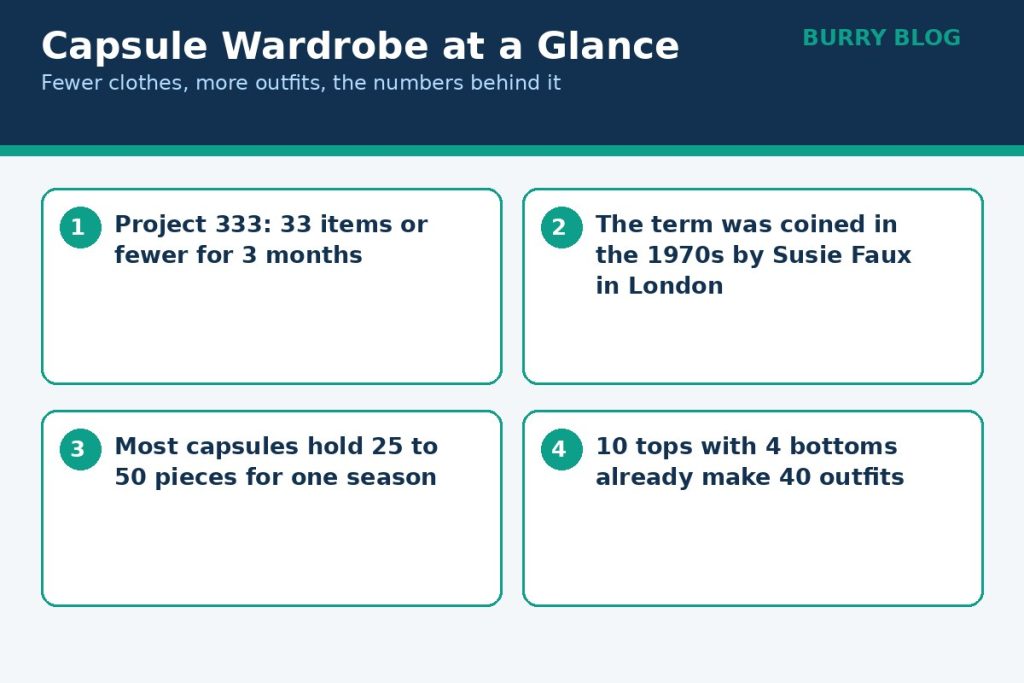
The most famous version of this idea is Project 333, the challenge Courtney Carver started in 2010 on her site Be More with Less. The rules are plain: dress with 33 items or less for 3 months, counting clothing, accessories, jewelry, outerwear and shoes, and box up everything else. A wedding ring or sentimental jewelry you never
take off does not count, and neither do underwear, sleepwear, in-home loungewear or workout clothing, as long as the workout clothes are only worn to work out. If something in your 33 stops fitting or wears out, you replace it rather than suffer in it. You do not have to adopt her numbers. Plenty of people run a 40 piece minimalist capsule wardrobe and get the same calm mornings out of it. Treat the 33 as proof it can be done, not as a debt you owe anyone.
The Three-Month Box Test
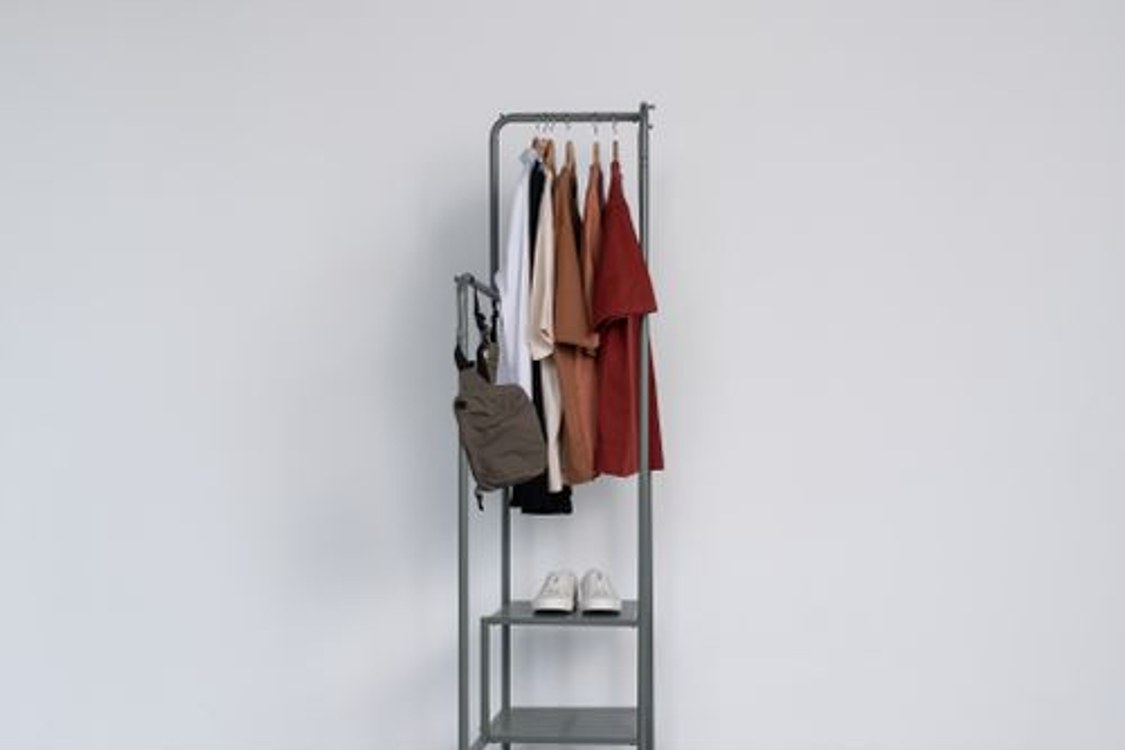
Once your chosen pieces are hanging in the closet, everything else goes into boxes. Project 333 is specific about this step: seal the box with tape and put it out of sight. The tape matters more than it sounds. An open box in the corner invites daily dipping; a sealed box turns each retrieval into a small decision, and most days you will not bother. Then live in the capsule for one full season, roughly three months. If you genuinely need something from the box, take it out and swap something else out to keep the rail honest. That is information, not failure.
At the end of the season, look at what is still sealed away. Three months of weather, work and social life passed without it, which is the most honest review a piece of clothing can get. Donate it, sell it, or store it knowing exactly what it is: surplus. Then rebuild for the next season. A seasonal capsule wardrobe solves the climate problem that puts many beginners off, because your winter rail and your summer rail are allowed to be different collections with a shared core.
One side effect shows up the first time you travel. Packing from a capsule wardrobe takes minutes, because everything already matches everything else and the decision work was done months ago. If you want to push that advantage further, our guide to packing light for any trip shows how a small wardrobe turns into a carry-on only system.
Mistakes That Quietly Wreck the Whole Thing
Buying a whole new wardrobe at once. This is the classic failure. A capsule bought in one spree is just a smaller pile of guesses, and an expensive one. Building a capsule wardrobe on a budget is not a compromise version of the method; it is the method. Start from what you own, then replace pieces one at a time as they wear out, with better versions of things you already know you wear.
Copying someone else’s list. Capsule wardrobe essentials for a designer who cycles to work in Copenhagen will not survive a car based office job in a hot climate. The counts transfer. The contents do not. Your audit, your palette and your calendar outrank any list on the internet, including the checklist further up this page.
Dressing for a fantasy life. Five party dresses and no decent work trousers is a costume box, not a wardrobe. A capsule has to serve the week you actually have, with maybe one piece kept for the life you are actively building. The rest of the fantasy can be rented, borrowed or bought later if the life ever arrives.
Going strict before you go small. Counting every scarf and earring toward a hard limit of 33 on your very first attempt is how beginners quit by Friday. Start looser, run the box test, learn what you wear, and tighten the count next season if you still want to. A capsule wardrobe for beginners should feel like relief, not homework.
Ignoring laundry reality. A capsule is a rotation, and rotations run on washing. If you do laundry once a week, you need enough of each category to cover a week plus a small buffer, or you will spend the experiment doing emergency midweek washes and blaming the method.
Frequently Asked Questions
How many clothes in a capsule wardrobe do you actually need?
Most seasonal capsules land between 25 and 50 pieces including shoes, and the best known challenge, Project 333, uses 33 items for three months. The right number for you is the smallest one that covers your real week and your laundry rhythm without stress. If you are constantly running out of clean tops, the count is too low for your life, whatever the internet says.
What is the difference between a capsule wardrobe and a minimalist wardrobe?
A minimalist wardrobe is mainly about owning fewer clothes overall. A capsule wardrobe adds two extra rules: nearly everything has to mix with nearly everything else, and the collection is usually built and reviewed season by season. Every capsule is minimalist, but a small random collection of clothes that do not pair up is not a capsule.
Can I build one without buying anything new?
Yes, and that is the recommended way to start. The audit and the box test use only clothes you already own, so your first capsule costs nothing. Spend later, slowly, on better versions of the pieces you wore out during the season, because by then you know exactly which gaps are real.
Do shoes, bags and jewelry count toward the total?
In Project 333 they do: clothing, accessories, jewelry, outerwear and shoes all count toward the 33, with exceptions for things like a wedding ring you never remove, underwear, sleepwear and workout clothes. In a looser home capsule it is your call. Count them if counting keeps you honest; skip the counting if it just makes you miserable. The mixing rule matters more than the bookkeeping.
How long should I try it before deciding whether it works?
One full season, about three months, using the box test. A fortnight is not enough data. Three months covers changes in weather, your full laundry cycle, work weeks, weekends and the odd event, which together are the honest test of whether a smaller wardrobe can carry your actual life.
The Bottom Line
A capsule wardrobe is not a test of discipline and it is not a shopping project. It is a small, well mixed set of clothes that fit your body, your palette and your calendar, built mostly from what you already own, then tested for a season while the rest sits sealed in a box. Start with the audit, keep the colours tight, let the box tell you the truth, and adjust without drama. Fewer clothes, more outfits sounds like a slogan. In practice it is just what happens when everything you own goes with everything else you own. For more guides like this one, browse our Fashion section, and you can find everything we publish on the Blog page.

Written by Fatima Noor
Fatima writes education, lifestyle and how-to guides for Burry Blog readers. Her focus is clear steps and practical detail: the things readers actually need to get something done.