

Most new exercise habits fail in the same quiet way. The plan is too big for the first week, the first missed day feels like proof it was never going to work, and by the second week the trainers are back in the cupboard. A morning walk is a rare exception, because the plan can be almost embarrassingly small and still count. Five minutes out the door, down the street and back, is a real walk. The trick is not doing more on day one. The trick is doing it again on day two, at the same time, without a decision to make.
This guide sits in our Health section, and it follows the guidance of the CDC, Harvard Health and the Mayo Clinic.
Key Points
- Five minutes a day in week one is enough; add five minutes each week until you reach 30 minutes.
- The CDC target is 150 minutes of moderate activity a week, and it can be broken into smaller chunks across the day.
- Supportive shoes, layers and a flat, well-lit route matter more than special gear.
- Stack the walk onto something you already do, and treat a missed day as a pause, not a failure.
In This Guide
- Why the Morning, Specifically
- How Much Walking Actually Counts
- How to Start a Morning Walk Habit in Four Weeks
- Shoes, Clothes and a Route That Works
- Walk Like You Mean It
- Rain, Cold and the Days You Do Not Feel Like It
- What Changes When You Keep Going
- Check With a Doctor First If Any of This Is You
- The Habit Is the Point
Why the Morning, Specifically
Any walk counts, at any hour. The morning earns its place for practical reasons, not magical ones. Before the day starts, nobody needs you yet. There are no meetings, no messages that cannot wait twenty minutes, and no chores competing for the same slot. The walk gets the first part of the day instead of whatever is left over at the end, and that difference is usually what decides whether it happens.
Morning light helps too. Getting outside in daylight early in the day is one of the simplest ways to keep your body clock on a steady schedule, and a steady schedule is what makes falling asleep at a normal hour easier. If sleep has been a struggle, the walk and the bedtime work as a pair, and our guide on how to sleep better covers the evening half of that deal.
How Much Walking Actually Counts
This is where most people overestimate what is required and then talk themselves out of starting. The CDC says adults need at least 150 minutes of moderate intensity physical activity a week, which works out as 30 minutes a day, five days a week, or 75 minutes of vigorous activity if that suits you better. Adults also need muscle strengthening activity on two days a week, though that is a separate job from the walk itself.
The important part is not the 150 minutes. It is that the CDC says you do not have to do it all at once. You can spread it across the week and break it into smaller chunks. A ten minute walk in the morning, another ten at lunch and ten after dinner adds up to the same thirty minutes, and the CDC is clear that some physical activity is better than none.
That means the goal for your first week is not 150 minutes. It is a habit that produces 150 minutes eventually, without you having to think about the number. Start with five or ten minutes a day, and let the minutes grow as the habit gets stronger.
How to Start a Morning Walk Habit in Four Weeks
A four week plan works because it separates the two jobs: weeks one and two are about showing up, weeks three and four about going further.
| Week | Goal | How it feels |
|---|---|---|
| Week 1 | Five minutes, every morning, same time | Almost too easy, and that is the point |
| Week 2 | Ten minutes, every morning, same time | Easy most days, with one day you have to push |
| Week 3 | Fifteen to twenty minutes, five days a week | A real walk, legs notice it, mood lifts after |
| Week 4 | Twenty to thirty minutes, five days a week | Part of the morning, missing it feels odd |
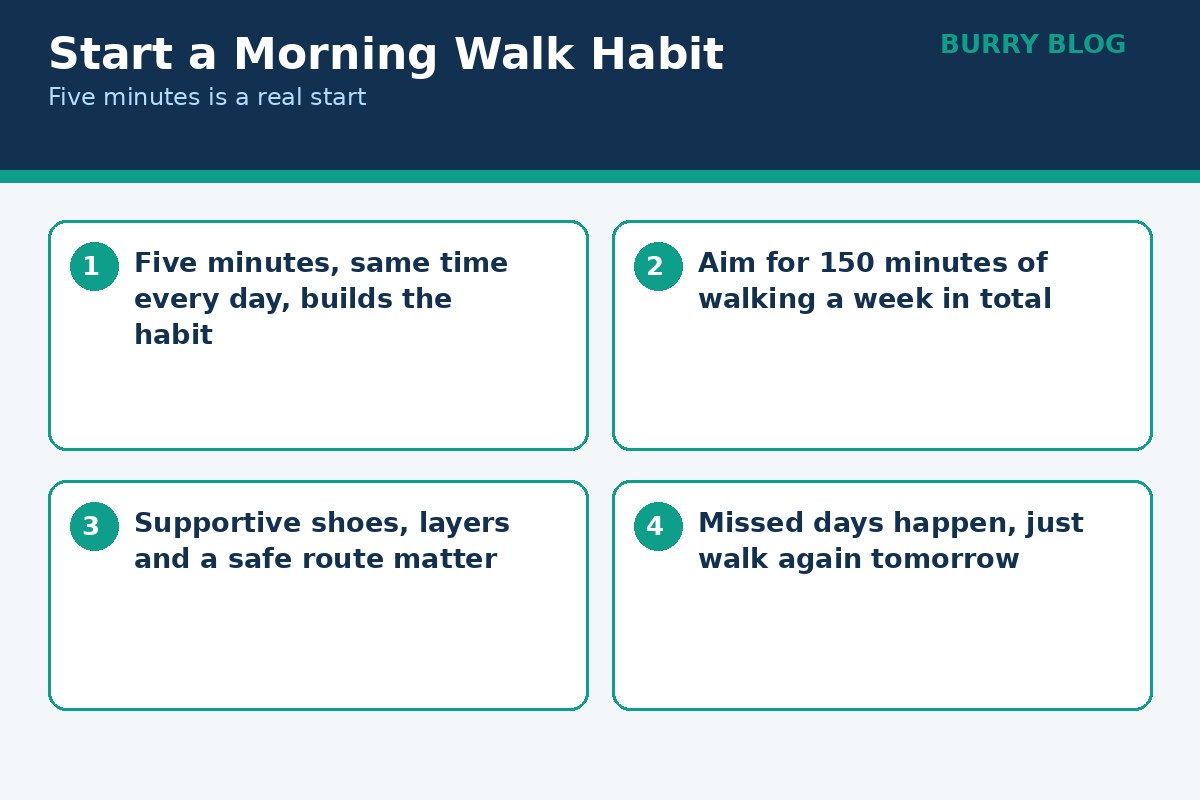
Week one is the most important week and the easiest to get wrong. Five minutes a day, every morning, at the same time. That is the whole assignment. The Mayo Clinic puts it exactly this way: start with five minutes a day in the first week, then increase your time by five minutes each week until you reach at least 30 minutes.
In week two, add five minutes. You are now walking ten minutes, still every morning, still at the same time. The time matters more than the distance.
Week three is where you add rest days, which sounds backwards but is the right move. Five days a week is the target the CDC uses, and five days means two days when you do not have to walk.
Week four is the consolidation week. Twenty to thirty minutes, five days a week, and you are at the weekly target without ever having done a heroic day. If a morning goes wrong and you miss the walk, the plan has room for it. Take missed days in stride and get back on track the next morning.
Shoes, Clothes and a Route That Works
You do not need walking shoes from a specialist shop to start, but you do need shoes that fit and do not hurt. Harvard Health says to look for supportive but flexible soles that cushion your feet. Shop at the end of the day, when your feet are at their largest, and choose breathable uppers such as nylon mesh. The Mayo Clinic adds the details to check: proper arch support, a firm heel, and thick flexible soles to cushion your feet and absorb shock.
Try the shoes on with the socks you will actually walk in, and walk around the shop in them before you buy. If your current trainers are comfortable for an hour of standing, they are probably fine for a ten minute walk.
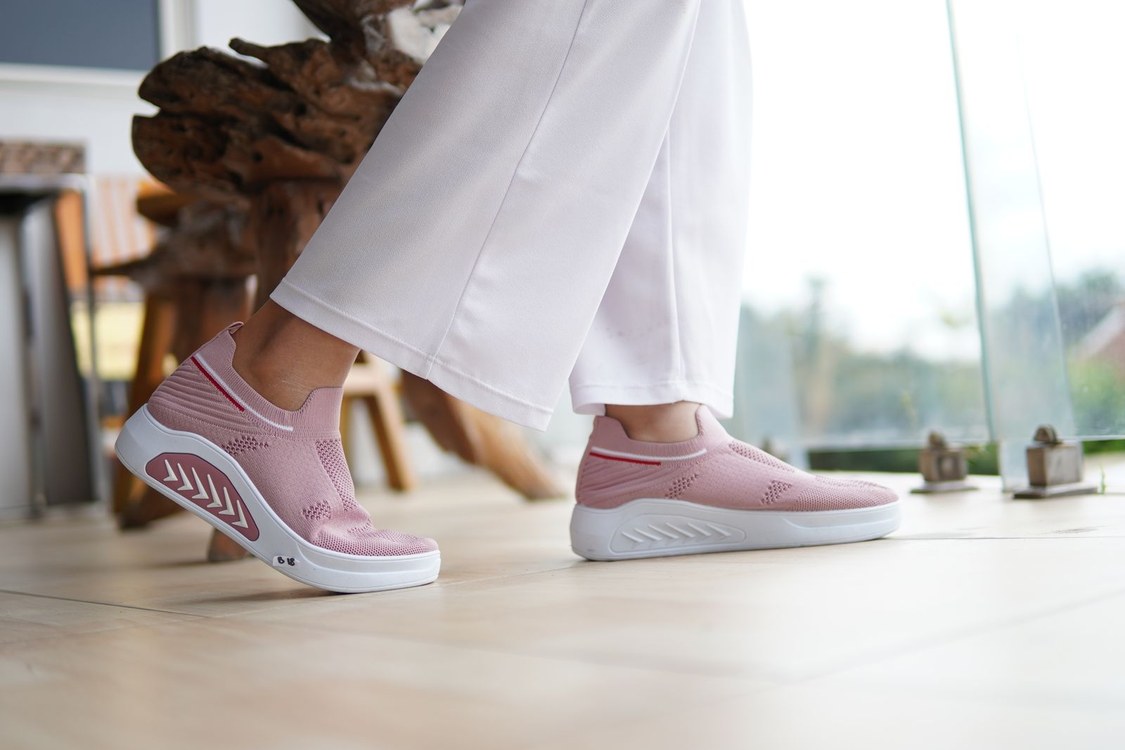
Clothes are simpler than people expect. Wear lighter clothes than you would need if you were standing still, because you will warm up fast once you are moving. Dress in layers, and in darker mornings wear light colored clothes or a reflective vest so drivers notice you.
The route deserves five minutes of thought on the first evening. Harvard Health lists the good options: quiet streets with sidewalks, park trails, athletic tracks at local schools, or shopping malls. Pick a flat, well lit route and walk it for the first two weeks.

Walk Like You Mean It
Walking well is mostly about not slouching and not staring at your feet. Stand tall, keep your head up with your chin level, and look ten to twenty feet in front of you rather than down at the pavement. Land on your heel, roll forward onto the ball of your foot, and push off from your toes. To speed up, take quicker steps instead of longer ones, because longer strides are what strain hips and knees.
The pace test is simple and comes from both Harvard Health and the Mayo Clinic: walk briskly enough to raise your heart rate, but still be able to carry on a conversation. If you are too breathless to talk, slow down. If you can chat easily and sing a song, you can probably push a little harder.
Start and finish gently. Walk slowly for five to ten minutes to warm up your muscles before you pick up the pace, and slow down again for the last five to ten minutes to cool down.
Rain, Cold and the Days You Do Not Feel Like It
Weather is the most common reason a morning walk dies, and it is also the easiest reason to solve, because the solution is decided the night before. If rain is forecast, lay out a light waterproof jacket with your clothes. If it is cold, lay out layers and a hat.
On genuinely bad days, move the walk indoors rather than skipping it. A shopping mall that opens early for walkers is the classic answer, and the Mayo Clinic names it directly. A few laps of a large indoor space keeps the habit alive on the days the weather refuses to cooperate.
Motivation is a weaker tool than most people think, and the habit does not need it once the routine is set. Three things work better. First, stack the walk onto something you already do every morning: after you brush your teeth, before you make tea, right after the dog goes out. Second, make the walk enjoyable on purpose. A friend who walks with you turns a chore into a conversation, and music or a podcast turns a quiet street into twenty minutes that belong to you. Third, track it in the simplest possible way. A tick on a calendar shows the chain growing.
What Changes When You Keep Going
The benefits of walking are not vague promises. Harvard Health lists five that surprised even the researchers. A study of more than 12,000 people found that brisk walking for about an hour a day cut in half the effect of 32 genes that promote weight gain. A fifteen minute walk can curb cravings for chocolate and other sugary snacks, even in stressful situations. Women who walked seven or more hours a week had a 14 percent lower risk of breast cancer than women who walked three hours or fewer.
Walking also looks after your joints rather than wearing them out. Several studies found that it reduces arthritis related pain, and walking five to six miles a week can even prevent arthritis from forming, because it lubricates the joints and strengthens the muscles that support them, especially the knees and hips. In cold and flu season, people who walked at least twenty minutes a day, at least five days a week, had 43 percent fewer sick days than people who exercised once a week or less, and when they did get sick it lasted a shorter time with milder symptoms.
The Mayo Clinic’s list adds the everyday benefits that show up first: a healthier weight, better heart health and fitness, stronger bones and muscles, more energy, a better mood, sharper thinking and memory, better sleep, and less stress and anxiety. None of this arrives in week one. Most of it arrives quietly, in the second month.
Check With a Doctor First If Any of This Is You
Walking is usually safe for people of any age and any level of fitness, and Harvard Health says so plainly. It does not jar the joints or raise the heart rate to dangerous levels in the way harder exercise can.
Talk to your doctor first if you have chest pain, or if you get unusually breathless or dizzy during light activity. The same applies if you have a heart condition, high blood pressure, diabetes, or another condition you are already being treated for, or if you have been told in the past to limit exercise. None of that means you cannot walk. It means the starting point and the pace should be agreed with someone who knows your health. If you feel chest pain, severe breathlessness or faintness during a walk, stop, rest, and get medical help rather than pushing through it.
The Habit Is the Point
A morning walk habit is not a fitness project with a finish line. There is no day when you are done and can stop. That is the part people resist, and it is also the part that makes it work. The habit is the point, and the health benefits are what the habit delivers while you are busy doing something else.
So start tomorrow, not next Monday. Five minutes, same time, same route, shoes by the door tonight. When the month is over, you will have walked most mornings without ever having made a big decision about it, and that is what a habit looks like from the inside.
How long should a morning walk be for a beginner?
Five minutes a day in the first week is enough, and the Mayo Clinic suggests exactly that start. Add five minutes each week until you reach at least 30 minutes, which is the daily target behind the CDC’s 150 minutes a week.
What time is best for a morning walk?
The best time is the time you can repeat every day. For most people that is soon after waking, before work and messages take over the day. The exact hour does not matter as much as the consistency.
Do I need special shoes to start walking?
No special shoes are needed on day one, but comfortable shoes matter from the start. Look for proper arch support, a firm heel and thick flexible soles that cushion your feet, and try them on with the socks you will walk in.
Is it okay to walk every day, or should I take rest days?
Walking every day is fine for most healthy adults, and the CDC target works out as 30 minutes a day, five days a week, which leaves two rest days built in. Two planned rest days a week is a good balance, because a rest day is part of the plan rather than a failure.
What if I miss a day or a whole week?
A missed day is not a failed habit. Go out the next morning at the usual time, even if you only manage five minutes, and the chain starts again. A missed week is harder, so go back to five minutes a day rather than trying to restart at thirty.

Written by Fatima Noor
Fatima writes education, lifestyle and how-to guides for Burry Blog readers. Her focus is clear steps and practical detail: the things readers actually need to get something done.