

Online shopping moved the checkout line into your pocket. There is no drive to the store, no queue, no moment at the till where you can change your mind. A saved card, a one-click button and free shipping can turn a passing interest into a completed order in under a minute, often late at night, often from the sofa. The urge to buy used to have to survive a trip to the shop. Now it only has to survive a tap.
The numbers behind the habit are blunt. A NerdWallet survey of 2,090 US adults, conducted by The Harris Poll in October 2024, found that 22 percent of Americans had made impulse purchases that significantly impacted their finances in the past 12 months, and around 1 in 6 spent more on impulse purchases than they put into their retirement accounts in most months. This is not a story about careless people. It is a story about a system built to remove every pause, and this guide puts the pauses back. More practical money guides like this one live in our Finance section.
Key Points
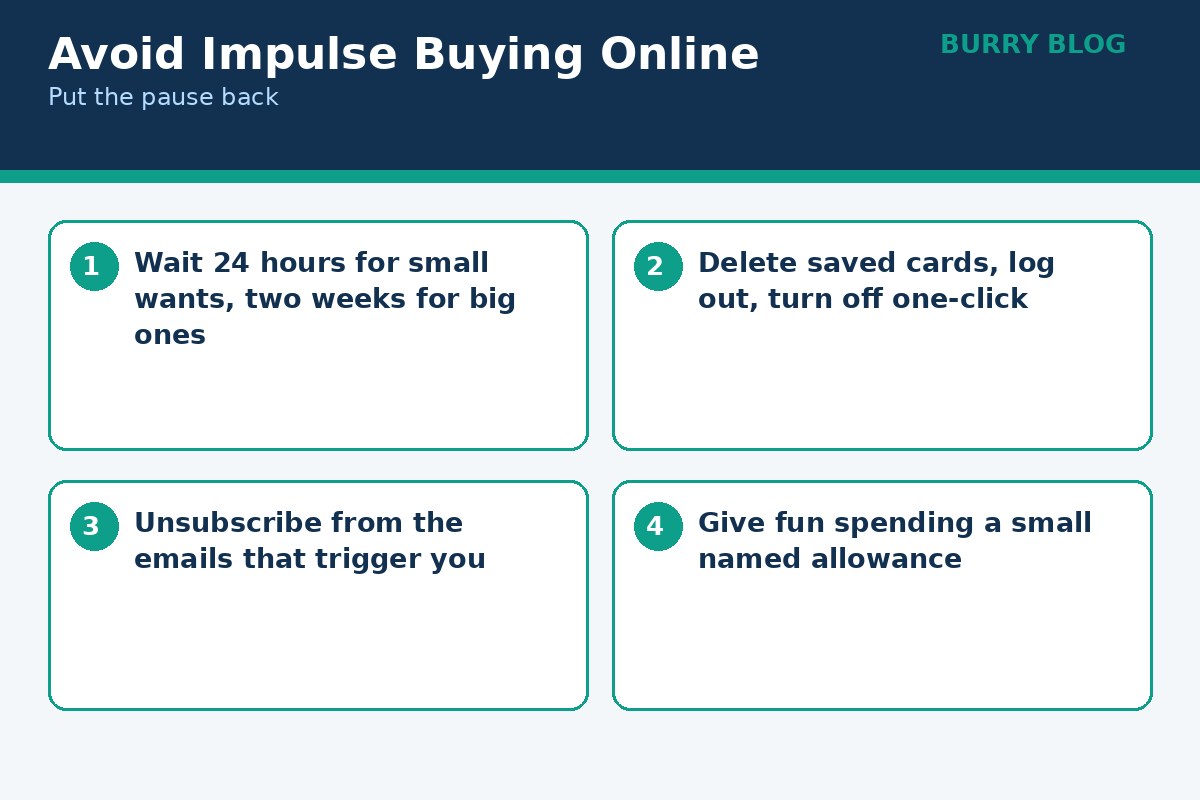
- Put time between wanting and buying: 24 hours for small wants, 72 hours above your limit, two weeks for big wants.
- Make buying slower: delete saved cards, log out of stores, turn off one-click checkout.
- Cut the triggers: unsubscribe from promo emails, unfollow the accounts that make you spend, stop buying after 8 p.m.
- Give fun spending a small named allowance, and send found money to the emergency fund first.
In This Guide
Why Online Shopping Makes Impulse Buying So Easy
The first thing to understand is that the difficulty is not a personal failing. Online stores are designed to make buying feel effortless, and the Federal Trade Commission has described the tricks in plain terms. Its September 2022 findings on dark patterns cover countdown timers that create a false impression of a limited-time offer, advertisements made to look like independent content, fees disclosed late in the checkout process, and subscription cancellation paths that are harder to navigate than sign-up. Samuel Levine, Director of the FTC’s Bureau of Consumer Protection, put it directly: “Our report shows how more and more companies are using digital dark patterns to trick people into buying products and giving away their personal information.”
Then there is the emotional side. NerdWallet calls it doom spending: making unnecessary purchases as a form of self-soothing in response to stress, often after doomscrolling. The writer of its guide describes it from her own evenings: after a long day, hitting purchase on a gym outfit or a scented candle calms her nervous system before bed. Johnson Rhett, a certified financial planner, explains the pull in one line: spending is something we can control, even if it is temporary, and it works as a type of coping mechanism. A small dopamine boost, a feeling of control, and then the package arrives and the feeling is gone.
Timing makes it worse. Gabbi Cerezo, a certified financial planner, notes that people generally have more willpower earlier in the day, and she avoids scrolling at night herself. That is when the feeds are most targeted and the guard is lowest. A product that feels made for you at 11 p.m. often looks ordinary at 9 a.m.
How to Avoid Impulse Buying Online With a Waiting Rule
The single most reliable trick is also the simplest: put time between wanting something and buying it. NerdWallet’s advice is a wishlist with a waiting period. Each time you see something you want that is not a necessity, you put it on a list with the date and the reason you want it. Then, after a set period of time, 48 hours, two weeks, whatever works for you, you revisit it and see if it is still something you want. Often, when you put time between the desire and the acquisition, you will find it is no longer a priority. And if it still is, you can buy it, if it is within your means to do so.
Make the rule concrete before the next urge arrives. For small wants, wait at least 24 hours. For anything above a limit you set in advance, wait 72 hours. For a big want, wait two weeks. The waiting period does the work that willpower cannot, because it lets the novelty wear off. NerdWallet’s own writer waits a month on her wishlist and says she then magically does not want the item anymore. The goal is not to keep you from ever buying things. It is to make sure the things you buy are the ones you still want after the excitement fades.
A second time rule helps at night. The NerdWallet writer’s own rule is simple and worth copying: she does not let herself buy anything after 8 p.m. She can search for products and add them to her cart, but no buying. Then she reevaluates her choices the next day, and that gives her a better sense of whether she really wants to spend the money or was just looking for a little comfort. If your worst purchases happen after dark, a clock rule is cheaper than a willpower rule, because the clock does not get tired.
What to Change When the Urge Hits
| Trigger | What to do instead | Why it works |
|---|---|---|
| A targeted ad in your feed | Close the app and add the item to your wishlist with the date | The ad loses its timing, and the wait tests whether you still want it |
| A countdown timer or “only 2 left” | Treat the timer as a warning sign and walk away for 24 hours | Pressure is a sales tactic, not a fact about the product |
| A late-night scroll | Stop buying after 8 p.m. and reevaluate in the morning | Willpower is lower at night, and most urges look smaller by daylight |
| A saved card and one-click checkout | Delete the saved card and log out of the store | Typing the details in by hand gives you time to think |
| A promotional email with a coupon | Unsubscribe on the spot and delete the message | The next coupon never arrives, so the next urge never starts |
| A free trial that turns into a paid plan | Cancel the trial the same day you start it | You keep the trial and remove the surprise charge |
Add Friction Before You Pay
The fastest way to buy less online is to make buying slower. NerdWallet’s guardrails start with the payment itself. Delete saved credit card information from shopping sites, remove retail apps from your devices, and log out of online stores. Each of those steps adds a small barrier between the urge and the order, and barriers are the point. Saved payment methods remove the speed bump between wanting something and buying it, so removing them means typing the details in by hand, which gives you time to think.
Turn off one-click checkout wherever the option exists, and turn off autopay for anything that is not an essential, predictable bill. One-click ordering and fast, free shipping mean you can have the thing you want in days, if not hours, without ever leaving your home. That convenience is exactly what the waiting rule is fighting. A useful extra rule is to stop buying on your phone: buy on a desktop computer or in person instead, because buying on a phone has become too fast and frictionless.
A debit card limits purchases to what is in your checking account, but it is not a safety net on its own, because the money still leaves. The better control is the one the Consumer Financial Protection Bureau found people actually wanted: real-time feedback on what is left to spend. In its research, over 90 percent of the consumers it talked to were interested in a tool that showed how much money was left in their budget at the point of purchase, and consumers thought such feedback would help them curb impulse spending. A weekly look at your statements does the same job with no new tool, and our guide on how to track your monthly spending shows the fifteen-minute routine.
Cut the Triggers at the Source
Waiting and friction handle the urge once it arrives. The next step is to stop so many urges from arriving. NerdWallet’s survey advice is blunt about this: unfollow and unsubscribe. When you are first motivated to save money and shop less, it is easy to imagine you can conjure up willpower every time your favourite store emails you a coupon or a relatable influencer posts a must-have purchase. But once that motivation wanes, it becomes harder to say no. Instead, set guard rails for the person you are, not the person you aspire to be, and unfollow and unsubscribe from the accounts and emails that lead you to spend impulsively. Trevor Gunter, a certified financial planner, did exactly this after realising targeted ads had led to unplanned purchases: he unsubscribed from every promotional email he gets, even from his favourite brands.
Kevin Feig, another certified financial planner, suggests putting on what he calls “financial blinders”, like a horse in a race. That means reducing news consumption, social media scrolling and other triggers that could lead to an unplanned purchase. Cerezo adds a practical version of the same idea: use your phone settings to set up time limit restrictions for social media and news apps, and avoid scrolling at night. Marking shopping or haul content as “not interested” retrains the algorithm over time, and closing shopping tabs when you are not researching a planned item removes the open invitation to browse.
None of this is perfect: most people will still see tempting ads every day. But removing the known triggers avoids some impulsive shopping, and some is a real saving over a year.
Write the List Before You Open the App
Impulse buying starts before the app opens, with a vague intention to “have a look”. A written list turns that look into a job with edges. Before you browse, write down the item or the problem you are trying to solve, in one sentence, and add the maximum total amount you are willing to spend, including delivery and other charges. The FTC’s online-shopping guidance puts this in practical terms: first, plan ahead by setting a budget. A written limit is easier to apply than a vague intention to be careful once an attractive product is on screen, and the limit should be a ceiling, not a target.
Then sort the list into wants and needs and keep the two apart. NerdWallet’s spending-plan advice adds the part most budgets skip: a set amount for guilt-free spending. Gunter encourages clients to know their monthly spending number, including a set amount for guilt-free spending, so they can enjoy their money while still keeping shopping in check. Gunter also gives himself a hard rule of only two new clothing item purchases per month. A small, named allowance for fun spending works better than a total ban, because a total ban breaks at the first bad day and a small allowance survives it.
Set monthly caps per category before the month starts, one number for clothes, one for home items, one for gadgets, and check them weekly. When a category hits its cap, the answer for the rest of the month is the wishlist, not the checkout. Automating savings first makes the caps easier to keep, because the money for your goals leaves the account before the shopping starts. NerdWallet’s survey puts this first among its strategies: automate contributions to retirement or savings within a day or two of payday, pay the bills, and then freely spend what is remaining. If the savings already moved, an impulse buy cannot quietly spend it.

What to Do After an Impulse Buy
Sometimes the order still goes through. That is not a failure of the system, and it is not a reason to abandon it. The first step is practical: check the seller’s return policy immediately and act within the return window. A refund from a retailer with a good return policy beats store credit. Keep the receipt and the packaging until you are sure, and note the deadline on the day the package arrives.
The second step is a reset without shame. NerdWallet’s guide suggests cheaper relief instead: a walk, a call to a friend, a hobby. The urge was usually stress looking for relief, and a cheaper relief next time beats a lecture to yourself. Review your purchases once a week or once a month and look at what you bought, what you returned, and what you should have returned but did not. That short review spots the patterns, the categories that keep breaking, and the triggers that keep working, and it turns one mistake into a rule for next time.
The third step is to give the money a better job. The Consumer Financial Protection Bureau notes that once people track their spending, many find money to save for emergencies, unexpected expenses and goals. The first call on found money is an emergency fund, and our guide on building an emergency fund on a small salary walks through the same idea in detail, starting from a very small amount and building it up month by month. A returned impulse buy that becomes the first fifty dollars in an emergency fund is not a wasted lesson. It is the lesson, paid for once, and kept.
Frequently Asked Questions
How long should I wait before buying something I want online?
Wait at least 24 hours for small wants, 72 hours for anything above a limit you set in advance, and up to two weeks for a big want. NerdWallet’s wishlist-and-wait advice uses a waiting period of 48 hours to two weeks: put the item on a list with the date and the reason you want it, then revisit it. If you still want it after the wait, and it fits your budget, buy it.
Does deleting saved cards really help with impulse buying?
Yes, because it adds friction at the exact moment the urge is strongest. Saved payment methods remove the speed bump between wanting something and buying it. Deleting them means you have to type the details in by hand, which gives you time to think, and turning off one-click checkout does the same job.
Should I unsubscribe from all shopping emails?
Unsubscribe from the ones that lead you to spend, especially stores and influencers that regularly trigger unplanned purchases. NerdWallet’s advice is to set guard rails for the person you are, not the person you aspire to be. You will still see ads, but the known triggers will be gone.
What if I already bought something on impulse?
Check the return policy right away and act within the return window, keeping the receipt and packaging. Then review what happened without guilt: note the trigger, the time of day, and the category, and turn it into a rule for next time. A weekly review of purchases is how patterns become visible.
Is a small fun budget better than banning shopping completely?
Yes. A set amount for guilt-free spending lets you enjoy your money while keeping shopping in check, and a small allowance survives bad days better than a total ban. Pair it with monthly caps per category and automated savings first, so the money for your goals moves before the shopping starts.

Written by Ayesha Khan
Ayesha is Burry Blog’s senior editor. She writes about digital marketing, SEO and online publishing, and leads the site’s website reviews, checking what a platform really offers before explaining how to use it.