
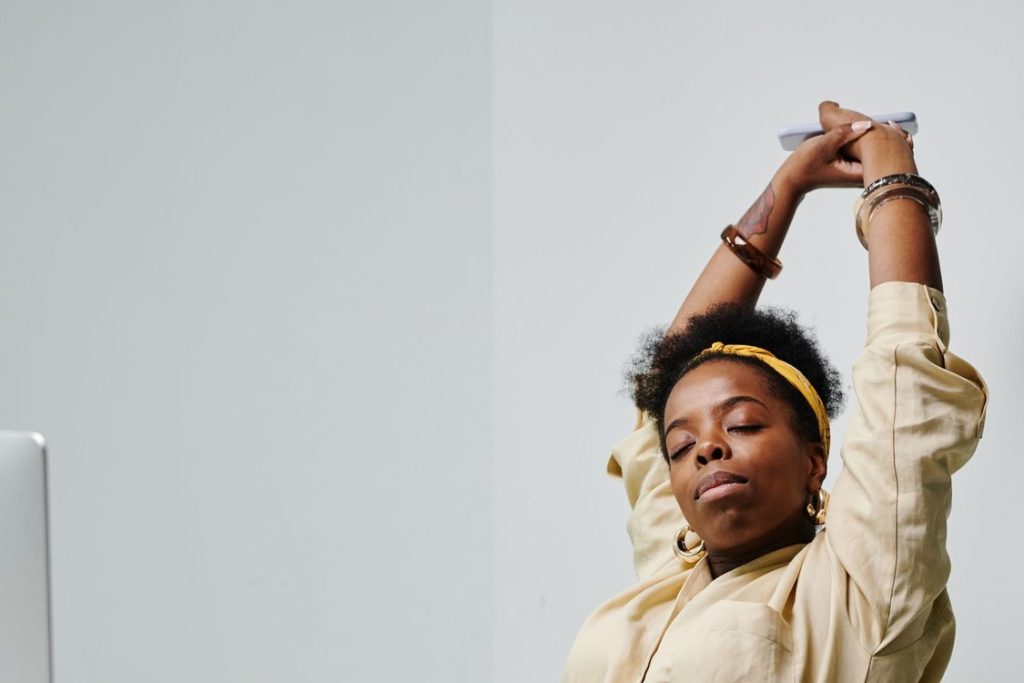
By mid afternoon, most desk workers know the feeling. Your neck has crept forward toward the screen, your shoulders are sitting somewhere up near your ears, and when you finally stand up, your hips and lower back take a few steps to unfold. Nothing is injured. You have simply held one position for hours, and your body has started to set in it.
The fix is not a gym session. It is a short set of stretches, done at your desk in ordinary clothes, that puts movement back into the joints a chair holds still. This guide builds one simple routine from guidance published by the NHS, Mayo Clinic, the HSE and the University of Waterloo Safety Office, using the hold times and break timings those sources actually give. More guides like this one live in our Health section.
Key Points
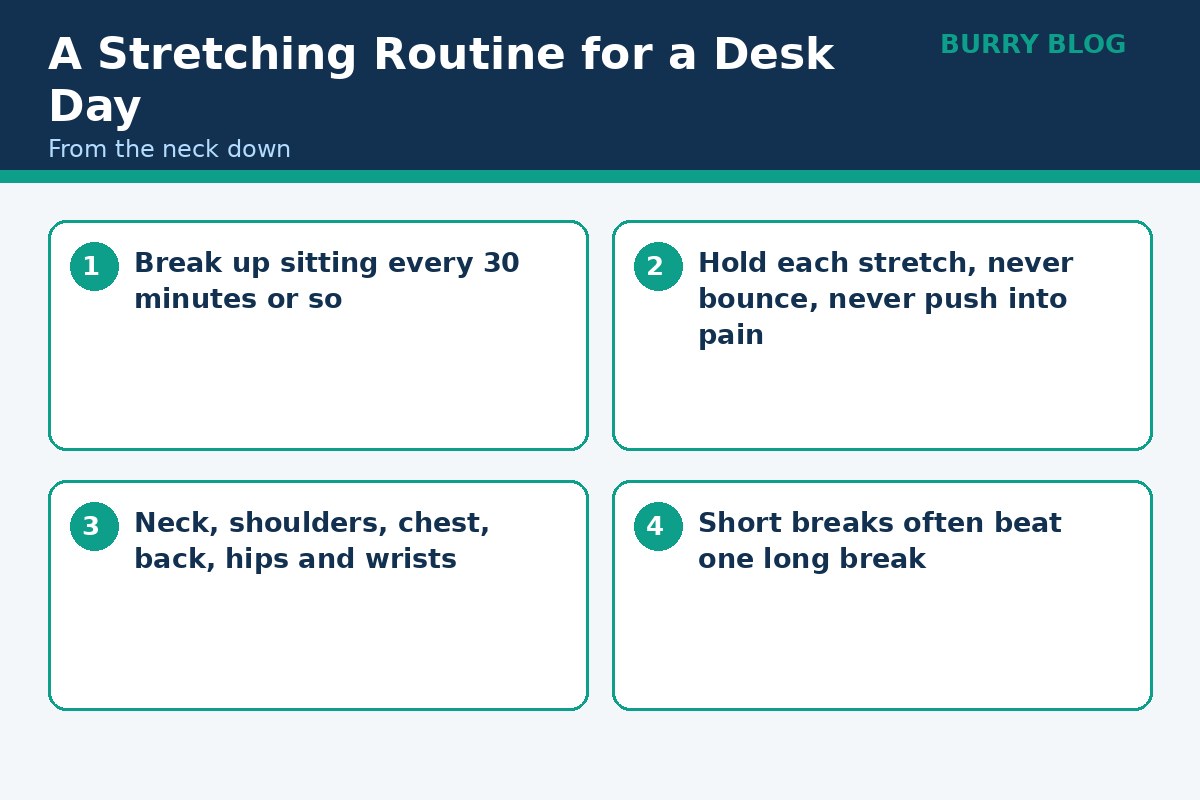
- Break up sitting every 30 minutes or so; short, frequent breaks beat one long one.
- Hold each stretch gently, never bounce and never push into pain.
- The routine covers neck, shoulders, chest, back, wrists, hips and calves in about ten minutes at your desk.
- Warm up with a short walk first, and check with a GP if you have an injury or are unsure the exercises suit you.
In This Guide
Why a Desk Day Leaves You Stiff
Desk work asks very little of your muscles, and that is the problem. When you sit, you use less energy than you do when you stand or move, as Mayo Clinic points out, and computer work involves very few changes of body position. Your neck holds your head at one angle, your shoulders round toward the keyboard, your chest stays closed, and your hips stay bent at much the same angle they took when you first sat down.
Held for an hour, that is rest. Held for six or seven hours, it becomes stiffness. The University of Waterloo Safety Office notes that stretching allows the body time to recover and helps prevent muscles from getting stiff, and the HSE guidance on screen work makes the related point that breaks must allow you to vary your posture, because it is staying in one posture that builds fatigue. Extended sitting has also been linked in research to wider health concerns, including obesity and the cluster of conditions that make up metabolic syndrome, which is why the answer is never just stretching. It is standing up and moving as well.
So a desk routine has two jobs. The stretches loosen the specific places a chair loads: neck, shoulders, chest, back, wrists, hips and calves. The breaks between bouts of sitting stop the stiffness building straight back up. You need both halves.
Start With the Chair and the Clock
The routine needs almost nothing, but the chair matters. The NHS asks for a solid, stable chair that does not have wheels, with your feet flat on the floor and your knees bent at right angles. It suggests avoiding chairs with arms, because they restrict your movement, and wearing loose, comfortable clothing with some water handy. If your office chair rolls, lock it or brace it before you start, and keep both feet on the floor for every seated move below.
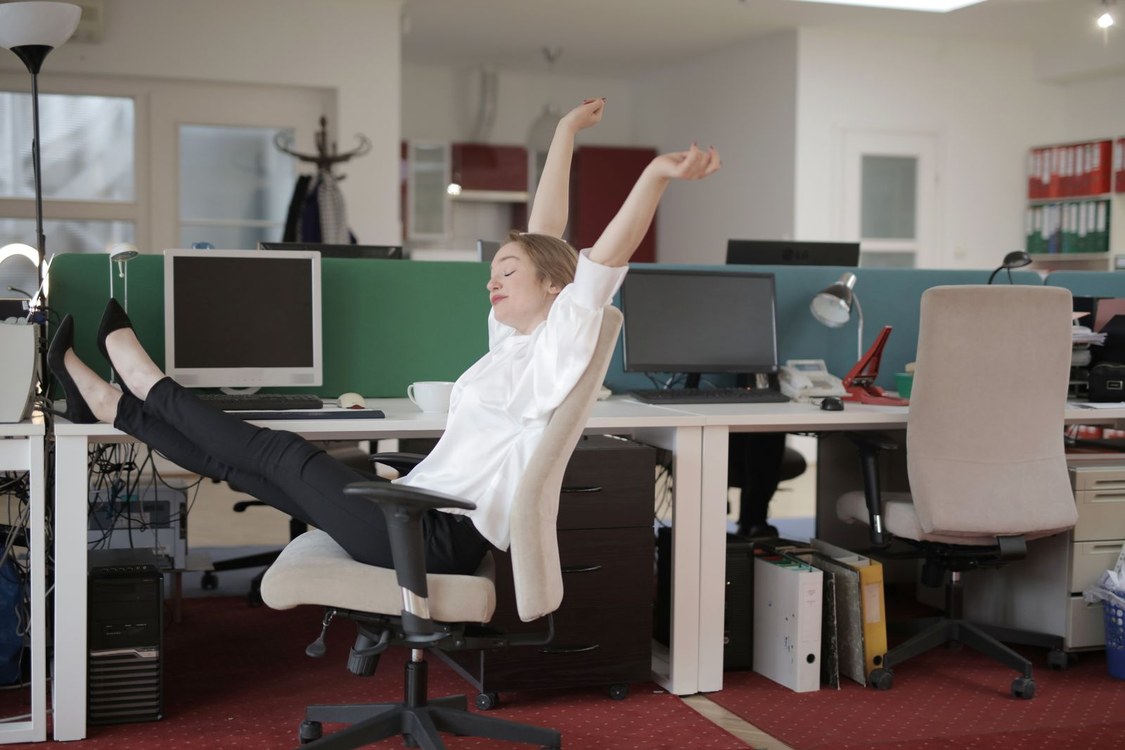
Then there is the timing, and the sources agree on the shape of the answer even where their numbers differ. Mayo Clinic suggests starting by simply taking a break from sitting every 30 minutes, even if the break is only standing up. The HSE guidance says short, frequent breaks are more satisfactory than occasional, longer breaks, and that a 5 to 10 minute break after 50 to 60 minutes of continuous screen work is likely to be better than a 15 minute break every 2 hours. It also stresses that breaks should be taken before fatigue sets in, not in order to recover from it. The University of Waterloo Safety Office recommends pausing to stretch at least once an hour, and a 5 minute stretch break every 30 minutes if your job is continuous data entry, adding that even a 30 second break is better than none at all.
A workable pattern for most desk days: stand up every half hour or so, run two or three stretches from the list below whenever something feels stiff, and do the full routine once, maybe twice, across the day. The full routine takes about ten minutes.
A Stretching Routine for a Desk Day, From the Neck Down
Work from the top down, so nothing gets skipped. Every hold and repetition below is the number its source gives, not a rounded guess. Move slowly, breathe normally, and stop at the point of a gentle pull.
Neck rotation. Sit upright with your shoulders down and look straight ahead. Slowly turn your head toward your left shoulder, as far as is comfortable, and hold for 5 seconds. Come back to the middle and repeat on the right. The NHS asks for 3 rotations on each side, and says the stretch is good for improving neck mobility and flexibility.
Neck stretch. Still sitting tall, hold your left shoulder down with your right hand and slowly tilt your head to the right, ear toward shoulder, while keeping that shoulder held down. Hold for 5 seconds and repeat 3 times on each side. The NHS describes this one as good for loosening tight neck muscles.
Shoulder shrugs and rolls. Raise the tops of your shoulders toward your ears until you feel slight tension in your neck and shoulders, hold for 3 to 5 seconds, then let them drop back down. Do that 2 or 3 times. Follow it with shoulder rolls: slowly roll your shoulders backward 5 times in a circular motion, then forward 5 times. Both come from the Waterloo set, where the shrug is listed as a way to relieve early tension in the neck and shoulders.
Chest stretch. Sit upright and away from the back of the chair. Pull your shoulders back and down, extend your arms out to the side, then gently push your chest forward and up until you feel the stretch across it. Hold for 5 to 10 seconds and repeat 5 times. The NHS says this stretch is good for posture.
Upper-body twist. With your feet flat on the floor, cross your arms and reach for your shoulders. Without moving your hips, turn your upper body to the left as far as is comfortable and hold for 5 seconds. Repeat on the right, and do 5 turns on each side. The NHS says the twist develops and maintains flexibility in the upper back.
Wrist and forearm stretch. Typing holds your wrists in one position for hours, so give them their own minute. Using one hand to help the other, slowly bend your wrist down until you feel a stretch, hold for 3 to 5 seconds, relax and repeat 3 times, then bend it slowly upward in the same way. Add the wrist tilt: with your hand open and facing down, gently bend the wrist from side to side, hold for 3 to 5 seconds and repeat 3 times. Both are from the Waterloo hand and forearm set.
Hip marching. Hold the sides of the chair, sit upright without leaning on the back, and lift one leg with the knee bent, as far as is comfortable. Put the foot down with control and repeat with the other leg, doing 5 lifts with each leg. The NHS says hip marching will strengthen hips and thighs and improve flexibility.
Ankle stretch. Finish the seated set with your ankles. Holding the side of the chair, straighten one leg with the foot off the floor. Point your toes away from you, then point them back toward you. Do 2 sets of 5 with each foot. The NHS notes that this improves ankle flexibility and lowers the risk of developing a blood clot.
| Stretch | Where you feel it | Hold / reps |
| Neck rotation | Sides and back of the neck | Hold 5 seconds, 3 turns each side |
| Neck stretch (ear to shoulder) | Side of the neck | Hold 5 seconds, 3 times each side |
| Shoulder shrug | Neck and shoulders | Hold 3 to 5 seconds, 2 or 3 times |
| Shoulder rolls | Shoulders | 5 backward, then 5 forward |
| Chest stretch | Across the chest | Hold 5 to 10 seconds, repeat 5 times |
| Upper-body twist | Upper back | Hold 5 seconds, 5 turns each side |
| Wrist flexion and tilt | Wrists and forearms | Hold 3 to 5 seconds, repeat 3 times |
| Hip marching | Hips and thighs | 5 lifts with each leg |
| Ankle stretch | Ankles and lower legs | 2 sets of 5 with each foot |
| Hip flexor stretch | Front of the hip | Hold about 30 seconds each side |
| Calf stretch | Back of the lower leg | 3 on each side |
| Low back reach | Lower back | Hold 5 to 10 seconds |
Stand Up for the Last Three
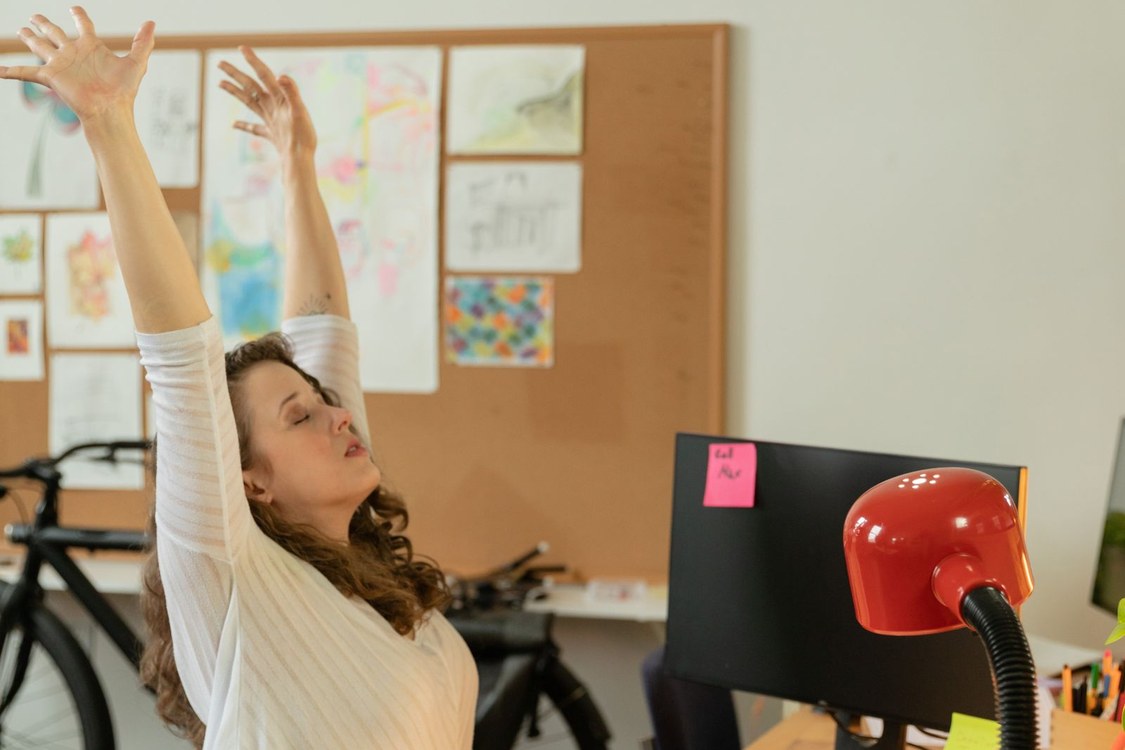
The Waterloo guidance makes a point worth following: stand up and move around when you stretch, because the change of posture is part of the benefit. Three stretches in this routine are better done on your feet.
Hip flexor stretch. Stand with a chair back or desk edge in reach for balance. Step one foot back, keep your back straight, and gently tuck your pelvis under until you feel a stretch down the front of the hip of the back leg. Mayo Clinic lists the hips among the major muscle groups to concentrate your stretches on, and its general guidance is to hold a stretch for about 30 seconds, so hold for about 30 seconds and then change sides.
Calf stretch. The NHS version uses a wall. Place your hands against the wall for stability, bend one leg and step the other leg back at least a foot’s distance, keeping it straight, with both feet flat on the floor. The back calf stretches as long as that leg stays as straight as possible and its heel stays on the floor. Perform 3 on each side. The Waterloo version holds the position for 5 to 15 seconds.
Low back reach. Stand up and lightly reach toward the ceiling. Hold for 5 to 10 seconds, then reach a little harder while taking a deep breath and hold for 5 seconds more before relaxing. The Waterloo set lists it as a way to relax the muscles of the low back and settle the spine after sitting.
The Safety Rules Are Part of the Routine
Stretching done badly can do more harm than good, and Mayo Clinic is blunt about the main rules. Do not bounce: stretch in a smooth movement, without bouncing, because bouncing as you stretch can injure your muscle and actually contribute to muscle tightness. Do not aim for pain: expect to feel tension while you are stretching, not pain, and if it hurts, you have pushed too far, so back off to the point where you do not feel any pain and hold the stretch there. Breathe normally while you hold, and stretch both sides, because flexibility that is not equal on both sides may be a risk factor for injury.
Two more cautions matter at a desk. Mayo Clinic advises against stretching cold muscles and suggests warming up with light walking first, so run this routine after a short walk, a trip to the printer or a kettle break, rather than the moment you sit down in the morning. And if you have a chronic condition or an existing injury, Mayo Clinic notes that you might need to adjust your stretching techniques, while the NHS advises checking with a GP or a health professional involved in your care if you are not sure the exercises are suitable for you. The NHS also says to build up slowly and gradually increase the repetitions over time, which is the right pace for the first week.
One last rule from Waterloo is the simplest of all. If any body part starts getting stiff between your planned breaks, take a moment and stretch that part out then. The routine is a framework, not a timetable you have to wait for.
Fitting It Into a Real Working Day
The routine survives only if it attaches to things you already do. Pair it with the breaks you take anyway: the kettle, the printer, the end of a call, the gap while a file uploads. If you work from home, our guide on how to stay focused while working from home is built around structuring the day into focused blocks with real breaks between them, and a stretch break is the most useful thing you can put in those gaps.
Run one extra round at the end of the day, before you close the laptop. It takes the same ten minutes, and it marks the point where work stops. If the day leaves you tense as well as stiff, our Sleep Better guide covers the evening habits that help you switch off properly.
Keep the whole thing small. The NHS suggests doing its exercise sets at least twice a week, and Mayo Clinic puts regular stretching at least two to three times a week for the general benefits, but a desk routine earns its keep daily precisely because it is short. Ten minutes, most of it seated, no kit, no changing clothes. That is the whole ask.
Frequently Asked Questions
How often should I stretch during a desk day?
More often than feels necessary. Mayo Clinic suggests a break from sitting every 30 minutes, the HSE favours a 5 to 10 minute break after 50 to 60 minutes of continuous screen work, and the University of Waterloo recommends pausing to stretch at least once an hour. A practical mix is to stand every half hour, stretch whatever feels stiff, and run the full routine once or twice a day.
How long should I hold each stretch?
Follow the number given for each stretch above. The NHS desk holds are short, mostly 5 to 10 seconds with several repetitions, while Mayo Clinic’s general stretching guidance is to hold each stretch for about 30 seconds, and around 60 seconds in problem areas. Short holds with repetitions suit a working day, because they fit inside a normal break.
Should stretching hurt?
No. Mayo Clinic says to expect tension while you are stretching, not pain. If a stretch hurts, you have pushed too far: back off to the point where you do not feel any pain, and hold the stretch there. Never bounce into a stretch to get further, because bouncing can injure the muscle and contribute to tightness.
Do I need any equipment or special clothes?
No. The NHS asks for a solid, stable chair without wheels, your feet flat on the floor, and loose, comfortable clothing, with some water handy. The standing stretches use a wall or a desk edge for balance. Everything in this routine can be done in normal work clothes, in the space beside your desk.
I have an old back or neck injury. Can I still do this routine?
Carefully, and only within what feels comfortable. Mayo Clinic notes that if you have a chronic condition or an injury, you might need to adjust your stretching techniques, and the NHS advises checking with a GP or a health professional involved in your care if you are not sure the exercises are suitable for you. Skip any stretch that causes pain, and get advice before adding new movements around an old injury.
Written by Fatima Noor
Fatima writes education, lifestyle and how-to guides for Burry Blog readers. Her focus is clear steps and practical detail: the things readers actually need to get something done.